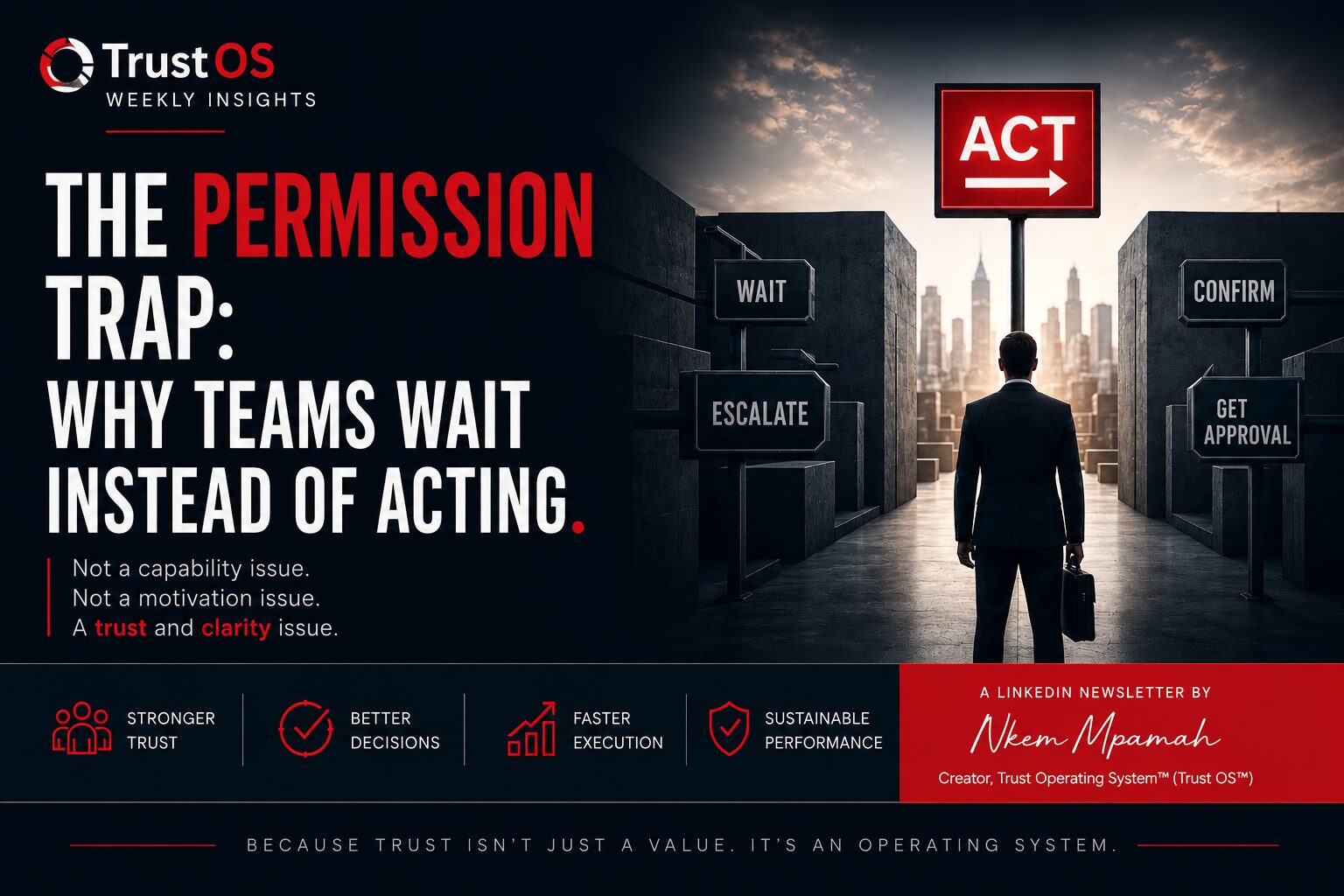
The Permission Trap may be the most expensive problem in your organization. It happens when capable people stop taking initiative and begin waiting for signals, approval, or reassurance before acting.
Think about the last time a project moved more slowly than expected. The team was capable, resources were available, and the work itself was clear. On paper, there was no reason for delay. Yet progress stalled. If you looked closely, you would likely find a consistent pattern across the organization: people were waiting. Not because they had been told to wait or because the work required it, but because at some point they paused and asked themselves a simple question—“Can I continue with this?” That question is rarely spoken aloud, but it shapes behaviour every day. I call this the Permission Trap.
What the permission trap looks like
The Permission Trap does not announce itself in obvious ways. Instead, it appears in the language people use around their work. You hear it when someone says they need to “just confirm first,” or that they will “wait for a clearer signal,” or that they “don’t want to overstep.” On the surface, this sounds thoughtful and professional. In certain situations, it is. But when it becomes the default response to every meaningful action, it is no longer professionalism—it is self-protection.
What makes this problem difficult to detect is that waiting is rarely enforced. There is usually no formal policy requiring delay, nor is there explicit instruction to hold back. The hesitation is self-imposed and shaped by the trust environment in which people operate.
Where invisible permission lives
People do not become cautious by accident. They respond to what their experience has taught them.
Unclear authority.
When authority is unclear, people tend to draw conservative boundaries around their role. They would rather ask unnecessarily than act and risk being told they overstepped. Ambiguity does not create initiative; it creates caution.
A history of correction without explanation.
The same pattern emerges when people have been corrected in the past without a clear explanation. Even a single instance of being pulled back after taking initiative can leave a lasting impression. The lesson becomes simple: acting without permission is risky. Over time, that lesson becomes behaviour, and behaviour becomes a habit.
Absence of visible leadership backing.
People also watch what happens around them. When they see decisions reversed without explanation or ownership quietly reassigned after the fact, they draw conclusions about what is safe. Even if leaders do not intend to send this message, it is clearly received: moving forward alone carries risk.
Fear of being wrong in a low-forgiveness environment
In environments where mistakes are treated harshly, the pattern becomes even stronger. When being wrong is punished more than being slow, people naturally adjust their behaviour. Waiting begins to feel safer than acting. It becomes the rational choice, not a sign of weakness.
When this hesitation becomes widespread, it doesn’t just slow individual action. It begins to affect how decisions are made across the organization, creating patterns where teams revisit the same issues and progress stalls—something I explore in Why Your Team Keeps Circling the Same Decision.
No one decides to build a slow organization. They simply create conditions in which moving feels riskier than waiting — and then wonder why nothing moves.
The compound cost of the Permission Trap
Individually, these moments of hesitation may seem small. But when they occur across an entire team, they compound into something much larger. Work slows not because people lack capability, but because they are managing internal risks instead of driving progress. Teams appear busy, yet much of that energy is spent checking, confirming, and positioning rather than executing.
Over time, this pattern becomes measurable. Effort remains high, but decision-making slows across the organization—a dynamic that directly impacts performance, as I explore in Stop Measuring Effort. Start Measuring Decision Speed.
This is often misdiagnosed as a capacity problem. Leaders assume they need more people, better tools, or tighter processes. In reality, the gap between what the team could achieve and what it actually produces is a trust gap. It shows up as permission-seeking behaviour that no one formally designed, but that everyone has learned.
The permission trap pattern rarely exists in isolation. It is usually part of a broader issue where work is not flowing as it should across the organization, something I explore in Trust Infrastructure: The Hidden Problem Slowing Your Team.
What high-trust environments do differently
High-trust organizations operate differently. They are not without structure or boundaries, but those boundaries are clear, and people trust that operating within them is safe. Individuals understand what they can decide on their own, when escalation is necessary, and—most importantly—that acting in good faith will be supported, even if the outcome is imperfect.
That final condition is what changes everything. When people know they will not be punished for taking initiative, they stop protecting themselves from taking action. They begin to act with confidence, and work starts to flow naturally.
How to fix the permission trap issue
Solving the Permission Trap does not begin with training. You cannot teach people to act boldly in an environment that does not support them. The solution starts with leadership taking an honest look at two questions:
First, have we made the boundaries of authority genuinely clear — not just in policy, but in practice? Do people actually know what they can decide, or do they know only what they are supposed to decide?
Second, what happens when someone acts within their authority and gets it wrong? Do they receive support, coaching, and a path forward, or do they receive distance and reassignment of blame?
The answers to these questions define the trust environment far more accurately than any cultural statement. When leaders clarify authority and consistently demonstrate support, people begin to trust the system again. When that happens, something shifts. People stop waiting for permission, and the organization starts moving again.
This article is part of the Trust Operating Systems series, in which I break down how trust shapes decision-making, execution, and growth inside organizations.
Start with the full framework here: Trust Operating Systems: How Organizational Trust Drives Execution
About the Trust Operating System™
Trust Operating System™ (Trust OS™) is a framework that helps boards, CEOs, founders, and executive teams uncover and close hidden trust gaps that hinder execution and reduce organizational performance.
To learn more about implementing Trust OS™ in your organization or to explore executive consulting, visit my website or connect with me on LinkedIn.
