
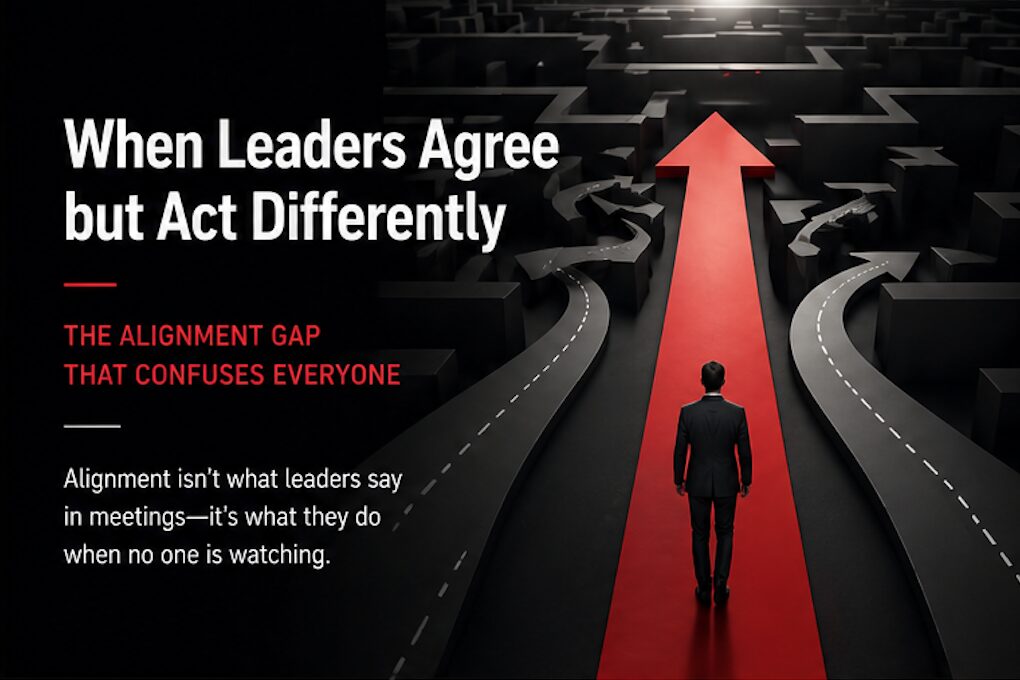
Leadership alignment in organizations breaks down when agreement in meetings does not translate into consistent action outside them. Many executive teams appear aligned in the room, yet behave differently afterward. This gap is not a communication issue. It is a trust problem that directly affects execution, decision speed, and organizational performance.
Agreement in the Room Is Not Alignment
In many leadership teams, meetings feel productive.
Discussions are thoughtful. Perspectives are shared. A direction is agreed. From the outside, it appears that alignment has been achieved.
But once the meeting ends, something changes.
Leaders return to their functions and interpret the decision differently. Some move forward with conviction, while others slow things down, revisit assumptions, or quietly redirect efforts. What looked like agreement begins to fragment in execution.
This is where leadership alignment in organizations breaks down—not during disagreement, but after agreement.
Why This Pattern Is So Common
This pattern is more common than most leaders admit, especially at the executive and board level.
It persists because agreement is often mistaken for commitment.
In reality, many leaders agree in meetings for practical reasons. They may want to keep the discussion moving, avoid open conflict, or signal support in the moment. But agreement under pressure is not the same as alignment in action.
True alignment requires something deeper: a shared commitment to carry the decision forward consistently, even when it becomes difficult or inconvenient.
When that commitment is missing, behaviour diverges after the meeting.
What Happens After the Meeting Ends
The real test of leadership alignment is not what is said in the room. It is what happens after.
Do leaders reinforce the decision in their teams? Do they communicate it clearly and consistently? And do they act in ways that support it, even when it conflicts with their functional priorities?
Or do they reinterpret, delay, or quietly adjust the direction?
When leaders act differently outside the meeting, the organization notices. Messages become inconsistent. Teams receive mixed signals. Execution slows as people try to interpret what really matters.
Over time, this creates the same pattern seen in looping decisions—where alignment appears to exist, but progress stalls. I explored this dynamic earlier in Why Your Team Keeps Circling the Same Decision.
This Is Not a Communication Problem
It is tempting to explain this as a communication gap.
Perhaps the message was not clear. Perhaps the decision was not documented properly. Perhaps more follow-up is needed.
These explanations are comfortable, but they are incomplete.
Leadership alignment in organizations does not fail because people did not understand the decision. It fails because they do not fully trust how that decision will hold over time.
If leaders believe that decisions may be revisited, challenged, or quietly reversed, they adapt their behaviour. They keep options open. They move cautiously. They wait to see how things unfold before committing fully.
This is a rational response to a low-trust environment.
The Impact on the Organization
When leadership alignment breaks down, the effects spread quickly.
Teams begin to hedge their actions. They delay execution, waiting for clarity that never fully arrives. Decision-making slows as people escalate issues upward instead of acting confidently at their level.
Over time, this affects execution across the organization—something I explored in Why Work Doesn’t Get Done (Even When Everyone Agrees).
The cost is not always visible at first, but it accumulates. Work takes longer. Energy is wasted. Opportunities are missed.
Most importantly, trust erodes—not just within the leadership team, but across the entire organization.
Why Leaders Behave This Way
Leaders rarely set out to create misalignment.
Their behaviour is shaped by experience.
If decisions have been revisited in the past, they learn not to commit too early. If alignment has been fragile, they learn to protect their function. If accountability has been uneven, they learn to manage risk rather than move decisively.
Over time, these patterns become normal.
Leaders appear aligned in meetings, but operate cautiously outside them.
What True Alignment Looks Like
In high-trust leadership teams, alignment is visible in action.
Decisions made in the room are reinforced consistently outside it. Leaders communicate the same message, support the same direction, and act in ways that strengthen the decision rather than weaken it.
There is no need for constant re-discussion or clarification. The organization experiences clarity because leadership behaviour is consistent.
This is what real leadership alignment looks like—not agreement in conversation, but consistency in execution.
The Shift Leaders Need to Make
If leadership alignment in your organization is inconsistent, the solution is not more meetings or better documentation.
The real question is simpler: Do we trust that decisions made together will be upheld consistently afterward?
This question changes the focus from communication to trust.
It invites leaders to examine where decisions have been revisited, where alignment has broken down, and where behaviour has diverged from agreement.
Until those patterns are addressed, alignment will remain fragile.
The Bottom Line
Leadership alignment is not proven in meetings.
It is proven in what leaders do after the meeting ends.
When leaders act consistently, the organization moves with clarity and speed. When they do not, execution slows, trust weakens, and progress stalls.
If you want alignment, don’t focus only on agreement.
Focus on the system that ensures agreement turns into consistent action.
This article is part of the Trust Operating Systems series, in which I break down how trust shapes decision-making, execution, and growth inside organizations.
Start with the full framework here:
👉 Trust Operating Systems: How Organizational Trust Drives Execution
About the Trust Operating System™
Trust Operating System™ (Trust OS™) is a proprietary framework for diagnosing and strengthening trust within organizations. It helps leaders remove friction, accelerate decision-making, and improve execution without adding unnecessary complexity.
Rather than focusing solely on how people feel, it focuses on how work moves—and fixes what slows it down. To learn more about implementing the Trust Operating System™ in your organization, visit nkemmpamah.com or connect with me on LinkedIn.
