Trust Operating System™ (Trust OS™)
The Trust-Based Performance System for High-Performing Organizations
Your Performance Problem May Not Be a
Strategy Problem. It May Be a Trust Problem
Every organization has a strategy.
Yet many still struggle with slow execution, weak accountability, leadership misalignment, declining customer confidence, and inconsistent results.
The problem is often not a lack of strategy, talent, or effort. It is the hidden trust gaps that quietly slow decision-making, weaken collaboration, and reduce performance.
Trust OS™ is a trust-based performance system that helps leaders uncover and close those gaps so people, teams, and organizations can perform at their best.
The Hidden Cost of Low Trust in Business
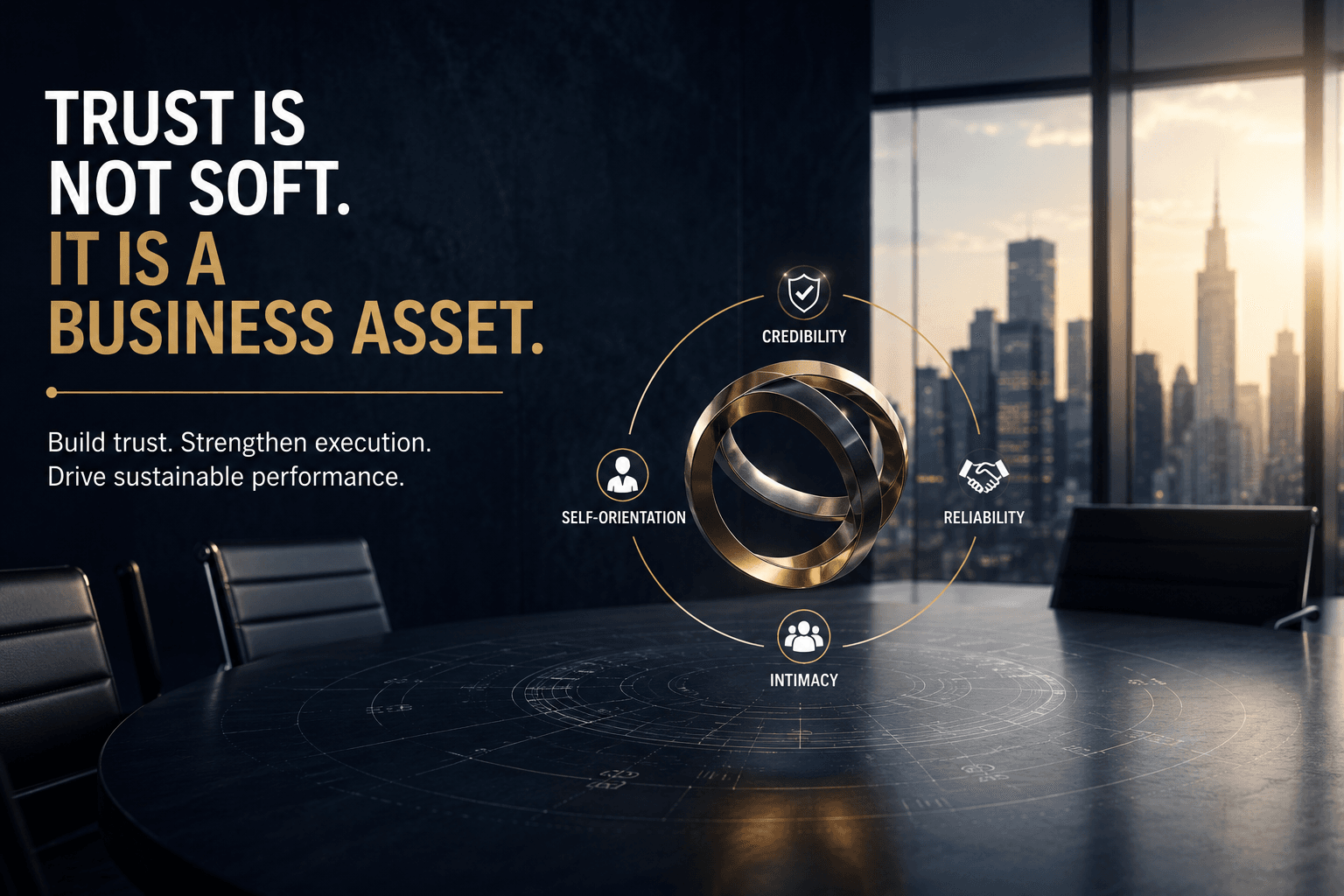
Trust is often treated as a soft issue. In reality, it affects almost every business outcome.
When trust is weak, organizations pay the price every day, even if the cost is not immediately visible.
Low trust shows up as:
- Decisions that take too long
- Endless meetings with little progress
- Poor accountability
- Teams working in silos
- Resistance to change
- Leadership fatigue
- Client hesitation
- Declining employee engagement
- Lost opportunities
- Slower growth
Most organizations try to address these symptoms with more meetings, new systems, or other strategies. The real issue often lies much deeper.
Trust is not merely a value to admire—it is a business asset to manage.
Is Your Organization Experiencing a Trust Gap?
Trust OS™ helps leaders identify and close those gaps so people, teams, and organizations can perform at their best.
Take a moment to reflect on this checklist:
□ Decisions keep getting delayed or revisited.
□ Teams work hard, but results remain inconsistent.
□ Accountability is often unclear or weak.
□ Leaders operate in silos instead of alignment.
□ Customers hesitate before making commitments.
□ Change initiatives struggle to gain traction.
□ Meetings produce discussion but little execution.
□ Growth has slowed despite having a clear strategy.
What does it mean for your organization?
If you checked three or more items on the list above, your organization may be dealing with hidden Trust Gaps.
What are trust gaps?
Trust gaps occur when team members don’t feel aligned or accountable. It impacts decision-making and overall results.
What are the effects of trust gaps?
Trust gaps lead to missed opportunities, inefficiencies, and frustration. It’s essential to address them quickly.
Why does this knowledge matter?
Identifying these gaps helps you address trust issues before they escalate in your organization. A proactive approach builds a stronger foundation.
The Trust OS™ helps leaders identify and close those gaps so people, teams, and organizations can perform at their best.
How can I identify trust gaps?
By monitoring team dynamics and performance. Use assessments like this checklist to gain insight into your organization.
Meet Trust Operating System™ (Trust OS™)
The Trust-Based Performance System
Just as every smartphone relies on an operating system to coordinate its applications and functions, every organization depends on an underlying operating system that influences how people think, decide, collaborate, and perform.
That operating system is trust.
When trust is healthy in an organization, people work together with confidence. Decisions move faster. Customers stay longer, teams become more accountable, innovation increases, and performance improves.
When trust is weak or broken, even the best strategies struggle to deliver results.
Trust OS™ provides leaders with a practical system for understanding, measuring, strengthening, and sustaining trust across leadership, teams, culture, and the customer experience.
What Trust Operating System™ looks like in an organization
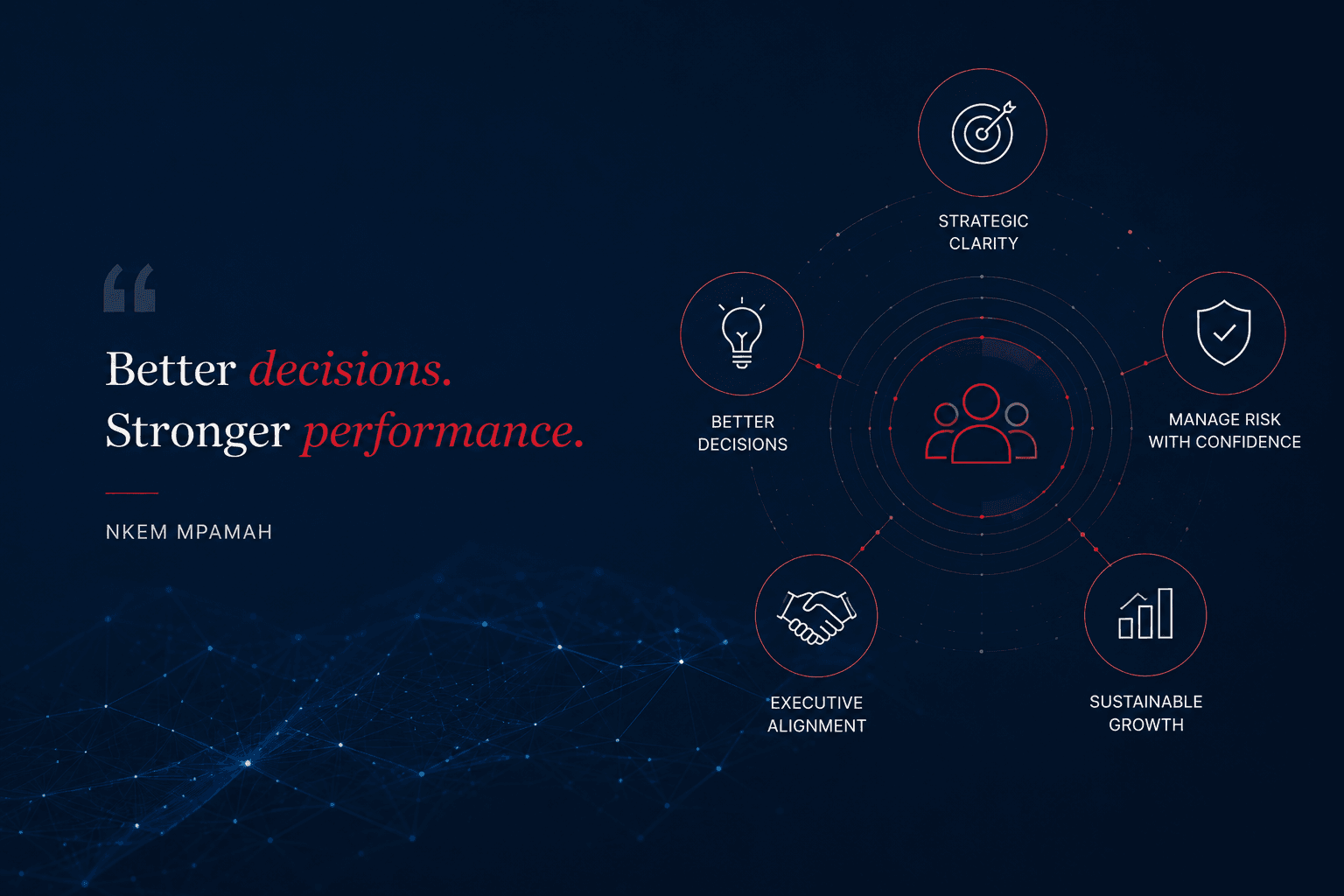
Quicker decisions
Faster execution
Aligned leadership
Minimal politics
Sustained accountability
Improved performance
How Trust OS™ Works
From Hidden Trust Gaps to Measurable Business Results
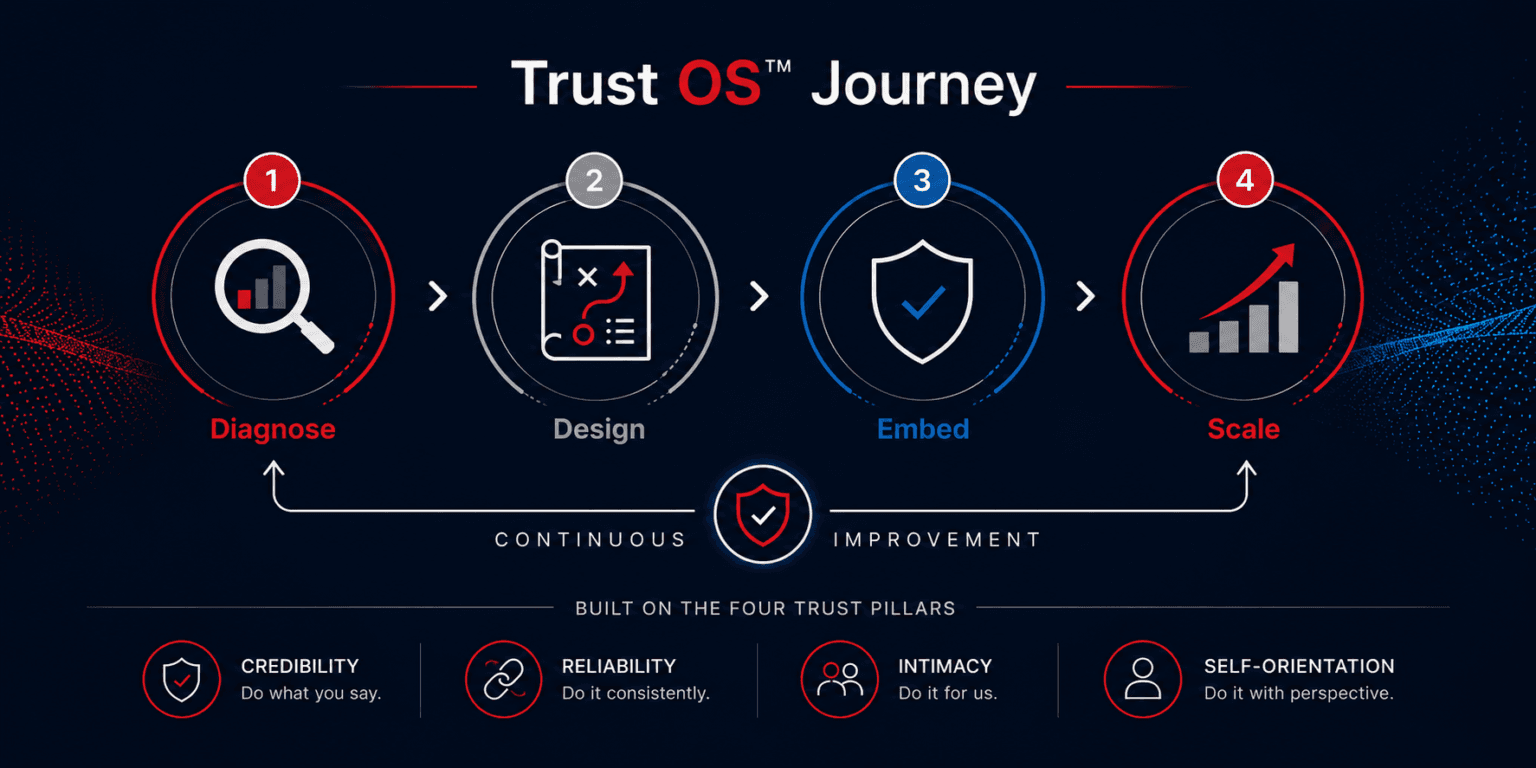
Trust cannot be improved by guesswork. It must first be understood. The Trust OS™ Journey follows a practical four-step process.
1. Diagnose
Identify the hidden trust gaps affecting leadership, teams, culture, and business performance.
↓
2. Design
Develop a practical trust strategy tailored to your organization’s needs.
↓
3. Embed
Build trust into leadership behaviours, systems, communication, and everyday operations.
↓
4. Scale
Create a sustainable culture where trust consistently drives performance and growth.
Because what gets measured can be improved, and what is embedded becomes culture.
The Five Dimensions of the Trust Operating System™
Clarity of Direction
When people are unclear, trust suffers. Clarity Trust ensures that people understand the organization's purpose, priorities, expectations, roles, and direction. When everyone knows what matters most, decisions become easier, collaboration improves, and execution accelerates. Clarity Trust Builds: Better alignment Faster decisions Reduced confusion
Decision Confidence
Confident decisions require trusted information and trusted leadership. Decision Trust helps leaders build confidence in how decisions are made, communicated, and supported. It reduces hesitation, second-guessing, and decision paralysis. Decision Trust Builds: Greater confidence Better judgment Faster decision-making
Execution Reliability
Strategies succeed only when people trust one another to deliver. Execution Trust strengthens consistency, ownership, and follow-through so commitments become results rather than intentions. Execution Trust Builds: Reliable execution Higher productivity Stronger results
Communication & Transparency
Trust grows when communication is open, honest, and consistent. Communication Trust removes uncertainty, reduces misunderstanding, and creates stronger alignment across teams and stakeholders. Communication Trust Builds: Better collaboration Greater transparency Stronger relationships
Accountability Ownership
People embrace accountability when trust is present. Accountability Trust creates a culture where individuals take ownership, keep commitments, and support one another in achieving shared goals. Accountability Trust Builds: Ownership Consistency Performance
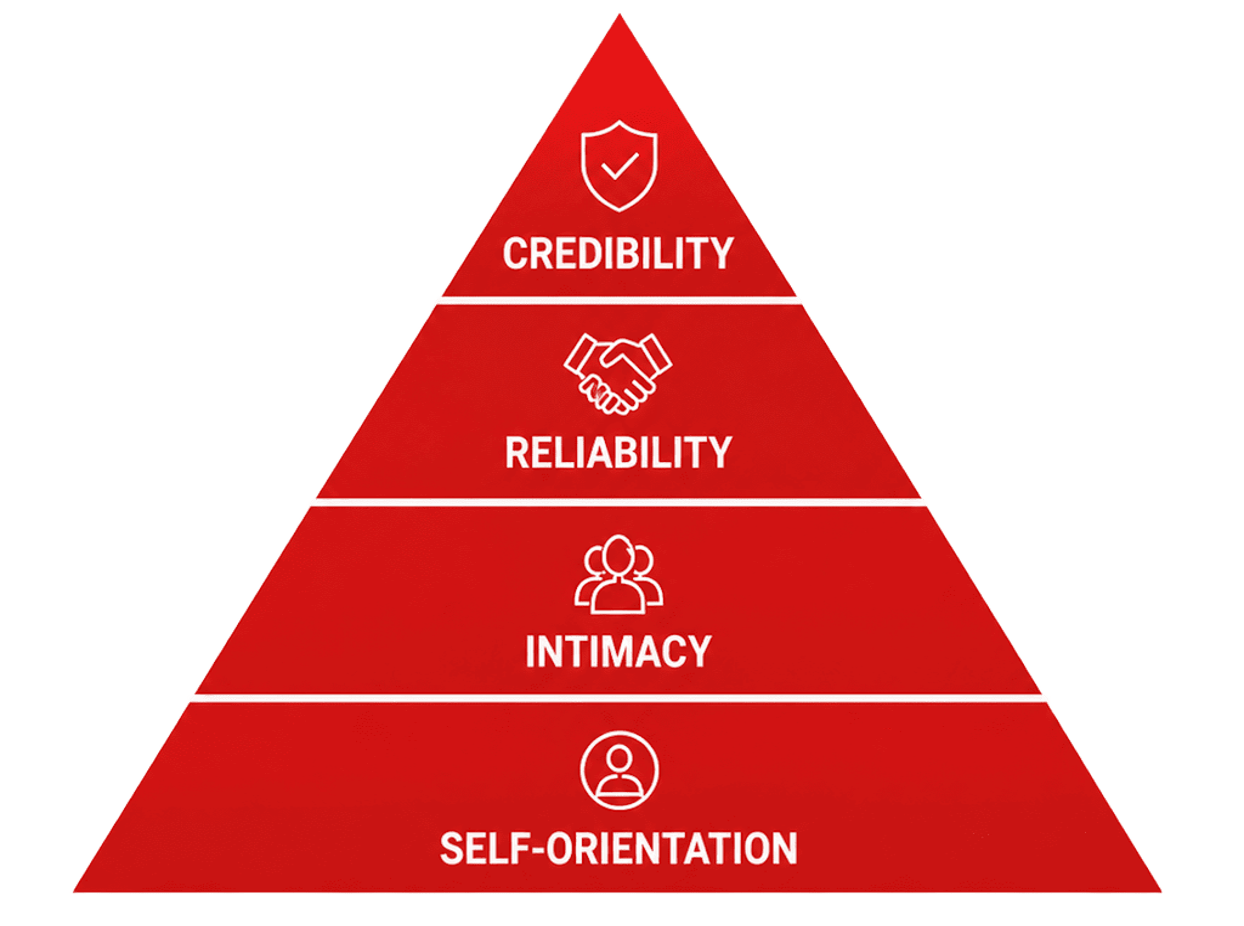
The Four Trust OS™ Pillars
Every Trust Gap Has a Root Cause
While trust appears complex, its foundations are remarkably consistent. Research and practical experience show that trust is built on four essential pillars. Trust OS™ helps organizations understand, build, and strengthen each one of these pillars.
Credibility
Do people believe what you say?
Confidence begins with competence, honesty, and integrity.
Reliability
Can people consistently depend on you?
Trust grows when promises become predictable actions.
Intimacy
Do people feel safe working with you?
Trust deepens when relationships are built on openness, respect, empathy, and genuine care.
Self-Orientation
Whose interests come first?
Trust increases when people believe decisions are made for the good of the team, customers, and organization—not personal agendas.
When one pillar weakens, trust weakens.When all four grow stronger, performance follows.
Diagnose Before You Design
Every successful transformation begins with a clear diagnosis.
The Trust OS™ Core Index is the diagnostic engine of the Trust Operating System. It helps leaders identify where trust is breaking down, uncover the underlying causes, and understand how those trust gaps are affecting organizational performance.
Rather than relying on assumptions or intuition, the Trust OS™ Core Index provides clear insights that enable leaders to make informed decisions and prioritize the actions that will have the greatest impact.
The Trust OS™ Core Index incorporates behavioural insights to reveal the leadership and organizational behaviours that strengthen—or weaken—trust across your organization.
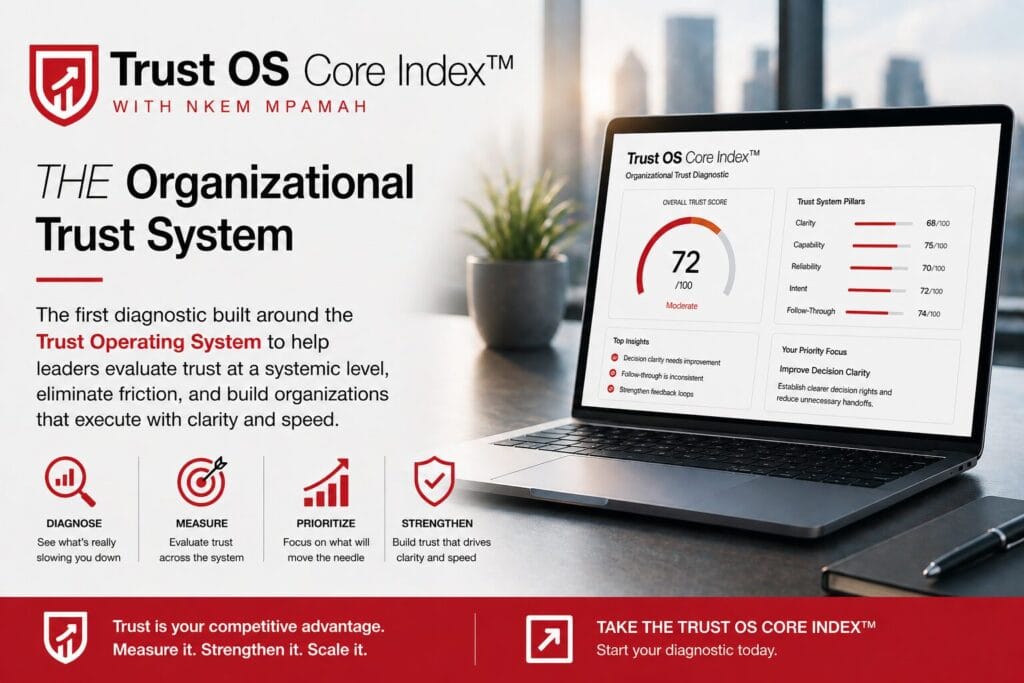
What it Measures
- Trust across the Five Dimensions
- Strength of the Four Trust Pillars
- Organizational trust maturity
- Leadership and team trust
- Behavioural trust indicators
- Priority improvement opportunities
- Trust strengths and blind spots
- Overall, Trust OS™ health
How to Diagnose Your Organization
What changes when trust improves in an organization
- Faster decision-making
- Better execution
- Stronger accountability
- Higher employee engagement
- Improved collaboration
- Greater customer confidence
- Better leadership effectiveness
- Increased innovation
- Higher productivity
- Sustainable business growth
Trust is not the end goal. Better business performance is.

Meet the Creator of Trust OS™
Nkem Mpamah is a Trust Strategist, Chartered Accountant, business advisor, speaker, and author dedicated to helping organizations improve performance through trust. After years of working with leaders and organizations, he observed that many business challenges—poor execution, weak accountability, customer attrition, leadership conflict, and stalled growth—shared a common root cause: Trust. This insight led to the development of Trust OS™, a practical system that helps leaders understand, measure, build, and sustain trust as a strategic business asset. His mission is simple: To help organizations transform trust into measurable business performance.
Trust in Action
Trust OS™ is more than a concept.
It is a practical system that has shaped leadership conversations, executive advisory engagements, workshops, keynote presentations, and organizational transformation initiatives.
Whether working with business owners, executives, leadership teams, professional associations, or growing organizations, the focus remains the same:
Helping leaders unlock measurable performance by strengthening trust where it matters most.