
- October 9, 2026
- Posted by: Nkem Mpamah
- Category: Organizational Trust
Executive Summary
Most leadership literature treats trust as an emotional, interpersonal, or cultural sentiment—something built through bonding exercises, open-door policies, or inspirational rhetoric.
In high-stakes enterprise environments, this framing creates a critical vulnerability. When trust is treated strictly as a moral or emotional virtue, executives struggle to measure it, boards fail to govern it, and organizations cannot systematically repair it when performance breaks down. To eliminate structural drag, leaders must examine how the four pillars of the Trust OS govern daily execution.
Trust isn’t primarily emotional. It is structural.
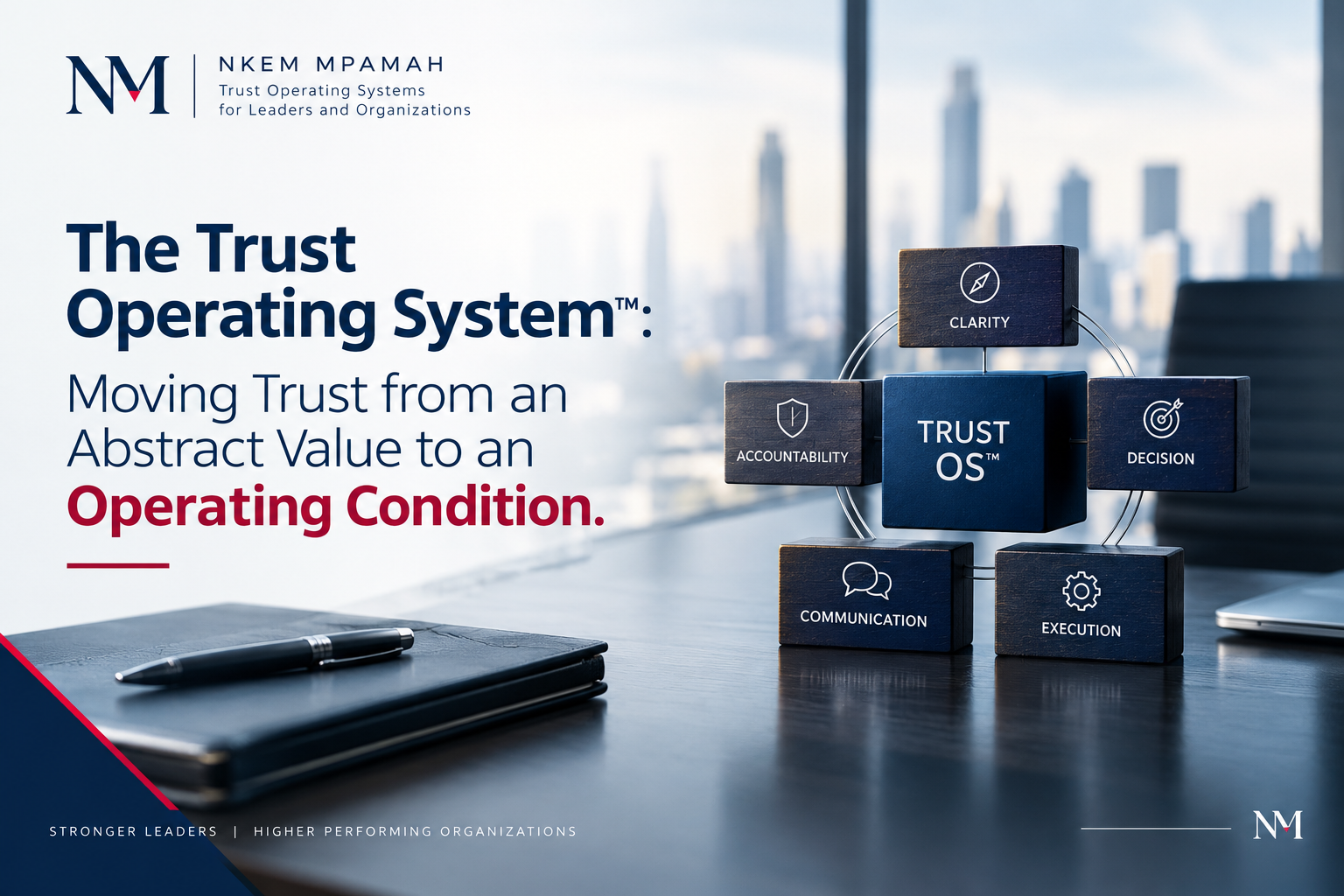
The Trust Operating System™ (Trust OS™) is a proprietary organizational performance framework that reframes trust from an abstract value into a leadership operating condition. Just as a computer’s operating system determines the speed, security, and stability with which applications run, an organization’s Trust OS determines the velocity, clarity, and reliability with which strategy is executed.
When organizational trust becomes intentional and structural, enterprises eliminate silent friction, accelerate decision velocity, and establish genuine accountability.
The Core Problem: The High Cost of the “Trust Tax”
When the four pillars of trust are low or inconsistent, organizations pay an invisible, highly compounding tax on every operational process. Problems that surface as issues of strategy, communication, or execution are almost always symptoms of underlying trust defects.
      INFORMATIONAL OPAQUENESS           FRICTIONAL DELAYS
      ┌────────────────────────┐      ┌────────────────────────┐
      │ Defensive Communication│      │ Multi-Layer Approvals  │
      │ Hidden Bad News        │      │ Re-opened Decisions    │
      │ Siloed Departments     │      │ Passive Execution      │
      └───────────┬────────────┘      └───────────┬────────────┘
                  │                               │
                  └───────────────┬───────────────┘
                                  │
                                  ▼
                     ┌────────────────────────┐
                     │     THE TRUST TAX      │
                     │  • Slow Execution      │
                     │  • High Drag           │
                     │  • Executive Burnout   │
                     └────────────────────────┘
1. Decision Drag
In a low-trust environment, decision-making requires excessive alignment meetings, redundant approval loops, and exhaustive documentation designed for self-protection rather than speed. Decisions made in executive sessions are routinely reopened, questioned, or passively delayed during implementation.
2. Informational Opaqueness
When executives feel that transparency carries career risk, bad news travels slowly up the reporting chain. Leaders end up making high-stakes strategic choices based on sanitized reports, delayed metrics, and optimistic projections that obscure operational realities.
3. Passive Execution & Ownership Deficits
When ownership conditions are unclear, managers default to compliance rather than initiative. They wait for top-down directions to insulate themselves from accountability, causing execution bottlenecks across every level of the enterprise.
The Paradigm Shift:
Emotional Trust vs. Structural Trust
To resolve systemic execution friction, boards and executive teams must distinguish between emotional trust and structural trust.
| Operational Dimension | Emotional / Interpersonal Trust | Structural Trust (Trust OS™) |
|---|---|---|
| Primary Definition | How people feel about one another. | The conditions under which people decide and execute. |
| Leadership Action | Team bonding, motivation, town halls. | System architecture, decision rights, feedback loops. |
| Measurement Focus | Sentiment surveys, employee net promoter score (eNPS). | Decision velocity, execution reliability, alignment index. |
| Operational Impact | Improves morale and workplace warmth. | Eliminates friction, accelerates throughput, enforces ownership. |
| Defect Resolution | Interpersonal mediation, conflict resolution. | Structural redesign, process re-engineering, governance clarity. |
The Trust Operating System™ Architecture:
The Governance Mechanics Behind High-Stakes Execution
In high-performing organizations, trust cannot be left to personality, goodwill, or individual leadership style. At the enterprise level, trust must be designed into how the organization is governed, how decisions are made, how information flows freely, and how commitments and execution are owned.
This is the role of the Trust Operating System™ Architecture.
It provides the structural framework through which an organization creates the conditions for people to make decisions with confidence, communicate with sufficient transparency, execute with consistency, and take ownership without excessive supervision. The trust infrastructure has become the new currency of business.
For CEOs and boards, this matters because many performance failures are not caused by a lack of capable people. They are caused by structural gaps in the operating environment: unclear authority, inconsistent decisions, information asymmetry, weak accountability, duplicate approvals, unresolved dependencies, or untrustworthy communication.
This is the role of the Trust Operating System™ Architecture.
It provides the structural framework through which an organization creates the conditions for people to make decisions with confidence, communicate with sufficient transparency, execute with consistency, and take ownership without excessive supervision.
For CEOs and boards, this matters because many performance failures are not caused by a lack of capable people. They are caused by structural gaps in the operating environment: unclear authority, inconsistent decisions, information asymmetry, weak accountability, duplicate approvals, unresolved dependencies, or untrustworthy communication.
The Trust Operating System™ addresses these issues through five interconnected operating conditions:
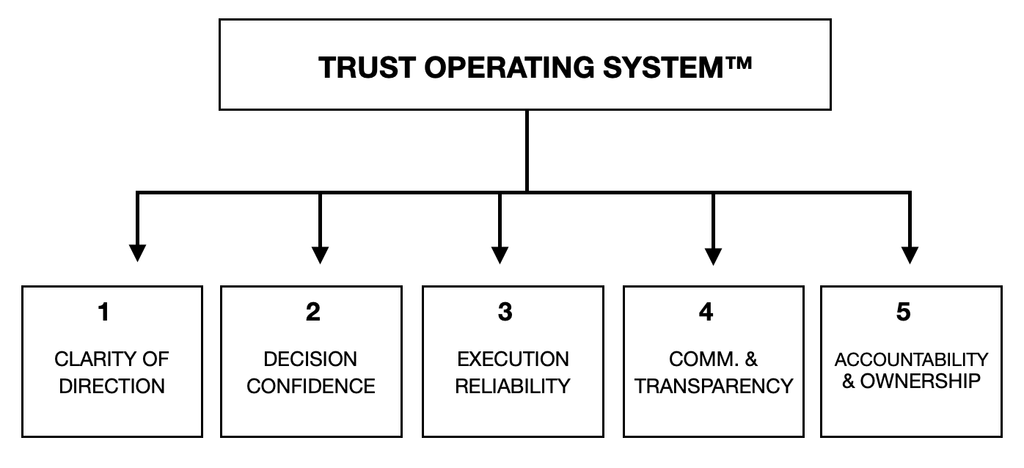
1. Clarity of Direction
Establishes whether leaders and teams clearly understand where the enterprise is going, what strategic objectives matter most, and what is expected at every level. Without directional clarity, misalignment creates wasted effort and conflicting priorities.
2. Decision Confidence
Examines whether leaders have total confidence in choices, decision rights, and the underlying reasoning behind strategic moves. High decision confidence eliminates multi-tier approval loops, defensive documentation, and the tendency to reopen finalized decisions.
3. Execution Reliability
Determines whether commitments, operational processes, and cross-functional dependencies consistently yield predictable, high-quality execution. It ensures strategy transitions seamlessly into operational reality.
4. Communication & Transparency
Governs whether critical operational data, bad news, and market feedback move openly, accurately, and at the velocity required by the business—without being filtered or sanitized for political self-protection.
5. Accountability & Ownership
Establishes unambiguous ownership boundaries across executive tiers. It creates an operating environment where leaders are empowered to take proactive initiative and can be relied upon to follow through on outcomes.
These dimensions operate across multiple levels of the enterprise—from board governance and executive leadership to functions, teams, and individual roles. The objective is not simply to create more trust between people. It is to create structural coherence across the organization.
The impact is consequential. When trust is structurally strong, organizations can reduce unnecessary checking and escalation, accelerate decision-making, improve cross-functional coordination, strengthen accountability, and execute strategic priorities with less friction.
In this sense, Trust Operating System Architecture is not a culture programme sitting alongside the business. It is part of the governance and performance infrastructure through which the business operates.
The Foundational Architecture: The Four Pillars of TRUST
The Trust Operating System™ does not exist in a vacuum; it is built upon the four core behavioural drivers articulated in Unlock The TRUST Code: Credibility, Reliability, Intimacy, and Self-Orientation. Together, these pillars explain the behavioural foundations upon which trust is established, experienced, and sustained within an organization.
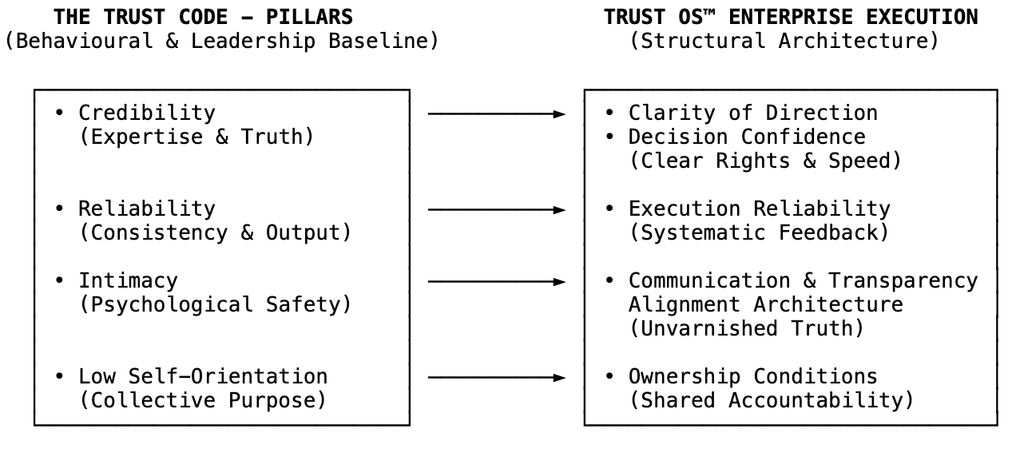
They represent the human dimension of trust: the behaviours, perceptions, and relational dynamics that determine whether people trust their leaders, colleagues, and the systems they work in.
Credibility concerns whether people believe what a leader says and have confidence in their competence and judgement. Reliability reflects whether commitments are honoured and actions remain consistent over time. Intimacy describes the degree to which people feel safe enough to speak candidly, raise concerns, share critical information, and engage without excessive fear or defensiveness. Self-Orientation examines the extent to which a person’s attention is directed towards personal interests rather than the interests of others or the wider organization. As self-orientation increases, trust can diminish—even where competence and results are evident.
These four pillars provide a behavioural lens for understanding why trust strengthens or deteriorates in leadership relationships and organizational interactions.
From Behavioural Foundations to Enterprise Architecture
The Four Pillars of TRUST and the Trust Operating System™ Architecture serve distinct but complementary purposes.
The Four Pillars provide the behavioural foundation. They help an organization understand the trust-related behaviours and relational conditions influencing how people interpret leadership, exchange information, collaborate, and honour commitments.
The Trust OS Architecture provides the organizational operating structure. It examines how trust is reflected in the mechanisms through which the enterprise establishes direction, makes decisions, coordinates execution, communicates, and enforces accountability.
In practical terms, the Four Pillars help explain the behavioural causes of trust-related challenges; the Trust OS Architecture identifies where those challenges manifest as operational friction, governance weaknesses, or performance constraints.
For an organization, this distinction is critical. A leader may be credible yet operate within a system of unclear decision rights. A team may have strong relationships yet struggle with inconsistent execution. Equally, well-designed processes may fail when leaders are perceived as unreliable or primarily self-interested.
The Four Pillars therefore provide a foundation for diagnosing and strengthening the human behaviours that support organizational trust, while the Trust Operating System translates that understanding into a structured approach to improving enterprise performance.
Together, they connect individual behaviour with organizational design—enabling leaders to move beyond treating trust as an abstract value and begin addressing it as a deliberate foundation for governance, leadership effectiveness, and consistent execution.
To explore the foundational research, diagnostic assessments, and leadership frameworks that underpin the system, read the book and methodology at Unlock The TRUST Code.
The Implementation Methodology:
Diagnose → Design → Embed → Scale
Transitioning from an informal approach to trust to a structured Trust Operating System™ requires more than leadership commitment or a change programme. It requires a deliberate process for diagnosing organizational conditions, designing appropriate operating mechanisms, embedding them into everyday practice, and extending them across the enterprise.
The Trust OS implementation methodology follows four integrated stages, each building on the outcomes of the preceding stage to create a sustainable foundation for organizational performance.

Stage 1: Diagnose — Establish the Baseline
The process begins with a structured assessment using the proprietary Trust OS Core Index™ to evaluate the organization’s trust-related operating conditions across five dimensions: Clarity Trust, Decision Trust, Execution Trust, Communication Trust, and Accountability Trust.
The diagnostic identifies where weaknesses in these conditions may be creating decision delays, executive misalignment, communication breakdowns, inconsistent execution, or accountability gaps. It establishes a baseline against which priorities can be determined, interventions focused, and subsequent progress evaluated.
Outcome: An evidence-informed picture of organizational trust conditions, critical performance gaps, and priority areas for intervention.
Stage 2: Design — Architect the Operating System
Using the diagnostic findings, the organization’s strategic priorities, leadership structure, and stage of growth, we design the Trust OS architecture required to support effective governance and execution.
This may involve clarifying decision rights, strengthening escalation pathways, redesigning executive meeting cadences, establishing communication and reporting protocols, defining ownership boundaries, and aligning accountability mechanisms. The objective is to ensure that the structures governing how people work together reinforce the behaviours and outcomes the organization expects.
Outcome: A tailored Trust OS architecture that connects leadership expectations, governance mechanisms, and operational requirements.
Stage 3: Embed — Integrate into Daily Operations
An architecture creates value only when it becomes part of how the organization actually operates. During this stage, the designed mechanisms are integrated into leadership routines, executive interactions, decision-making processes, and operational workflows.
Through executive advisory and facilitation, leaders and teams develop the capabilities and disciplines required to work within the new operating conditions. Responsibilities, reporting practices, escalation protocols, and follow-through mechanisms are reinforced so that progress depends less on individual intervention and more on consistent organizational practice.
Outcome: Trust OS mechanisms become embedded in leadership behaviour, management routines, and the everyday execution of organizational priorities.
Stage 4: Scale — Institutionalize and Extend
As the system becomes established, it is extended across relevant business units, management tiers, and cross-functional workflows. Governance arrangements, performance indicators, and review mechanisms are aligned to sustain consistency while accommodating the distinct operational requirements of each part of the enterprise.
Scaling also involves monitoring performance, identifying emerging gaps, and refining the architecture as the organization grows, restructures, enters new markets, or undertakes strategic transformation.
Outcome: An institutionalized operating system that supports organizational coherence, reliable execution, and sustained performance as complexity increases.
From Trust as an Aspiration to Trust as an Operating Discipline
The four stages form a connected cycle of organizational improvement: Diagnose reveals where attention is needed; Design establishes what must change; Embed translates the design into practice; and Scale extends and sustains its impact.
The result is a deliberate shift from relying on trust as an assumed cultural attribute to managing the organizational conditions that enable trust to support governance, execution, and performance.
Strategic Value for C-Suite Leaders and Boards
For CEOs, Board Chairs, Managing Directors, and executive teams, the Trust Operating System™ offers a structural approach to strengthening organizational performance. By addressing the trust-related conditions that shape decision-making, coordination, execution, and accountability, it helps organizations reduce operational friction and translate strategic intent into measurable business outcomes.
- Accelerated Strategic Execution: Clarifies decision rights, strengthens confidence in leadership decisions, and reduces unnecessary approvals, repeated deliberations, and execution delays—enabling strategic priorities to move forward with greater speed and consistency.
- Improved Capital and Resource Efficiency: Exposes the hidden costs of low trust, including duplicated work, excessive oversight, avoidable rework, prolonged meetings, and failed handoffs. Addressing these structural inefficiencies enables organizations to deploy financial, human, and operational resources more effectively.
- Stronger Governance and Executive Visibility: Gives boards and executive leaders a structured view of organizational trust and its implications for performance. By identifying weaknesses in clarity, decision-making, execution, communication, and accountability, Trust OS helps leaders recognize operational risks earlier and make better-informed governance and strategic decisions.
- Greater Leadership Capacity and Organizational Resilience: Reduces dependence on constant executive intervention by strengthening ownership, decision-making confidence, and reliable execution across the organization. This allows senior leaders to spend less time resolving avoidable operational friction and more time on strategy, growth, innovation, and long-term value creation.
Ultimately, the strategic value of Trust OS lies in making trust an intentional component of organizational design. Rather than relying on individual goodwill or periodic culture initiatives, leaders can address the operating conditions that determine how effectively the enterprise makes decisions, mobilizes resources, manages risk, and delivers results.
Conclusion: From Trust as a Value to Trust as Infrastructure
Trust is not an elusive quality that leaders must passively hope for. It is an organizational condition that can be assessed, deliberately designed, embedded into operating practices, and strengthened as the enterprise grows.
When trust is treated merely as a cultural aspiration, its impact on performance remains difficult to identify and manage. When it becomes part of the organization’s operating architecture, leaders gain a structured way to address the conditions that influence decision-making, communication, execution, and accountability.
The Trust Operating System™ provides a framework for making that shift—from relying on individual goodwill and constant executive intervention to building organizational structures that support alignment, reliable execution, and sustainable performance.
Ultimately, trust is not simply how people feel about one another; it is also reflected in how effectively work moves across the organization. As explored in Trust as Infrastructure, the way trust is established and maintained has direct implications for how organizations coordinate effort, manage complexity, and translate strategy into results.
For CEOs, board chairs, and senior executives, the starting point is not to assume that trust is either present or absent. It is to understand where the organization’s operating conditions support performance—and where they create friction, risk, or avoidable cost.
Assess Your Organization’s Trust OS
How effectively does your organization establish direction, make decisions, coordinate execution, communicate critical information, and enforce accountability?
The Trust OS Core Index™ Diagnostic provides a structured starting point for examining these five dimensions, identifying potential performance gaps, and determining where leadership attention may have the greatest impact.
To explore how the Trust Operating System™ could support your organization’s governance, leadership effectiveness, and execution priorities, request an executive briefing at advisory@nkemmpamah.com.
Build the conditions for trust. Strengthen the architecture of performance.
