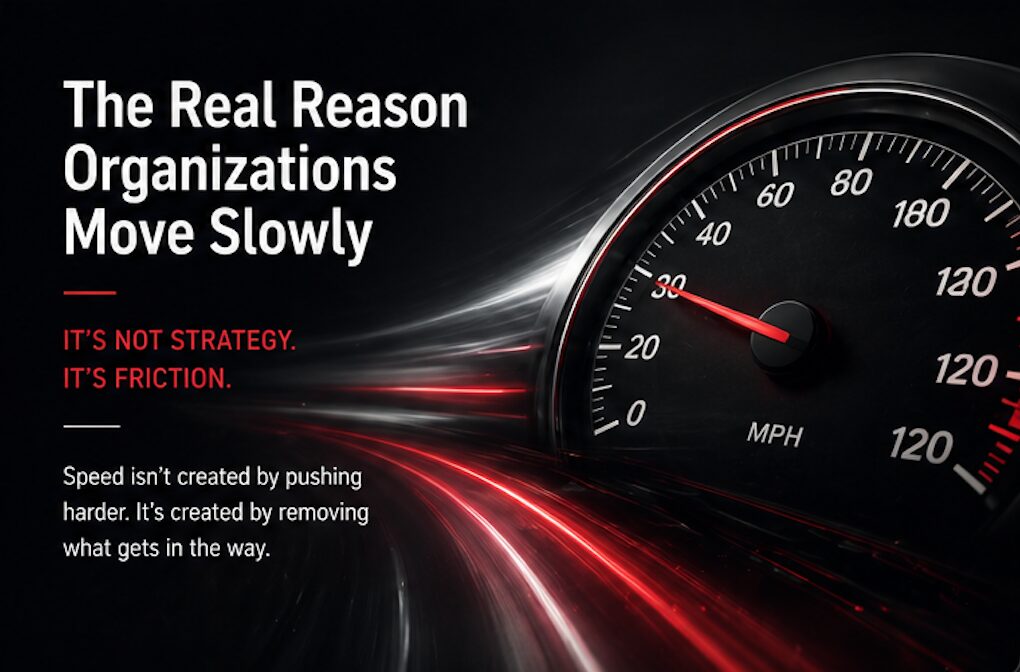
Organizational speed is the hidden factor behind the growth of fast-growing organizations. While many assume growth comes from strategy, talent, or capital, the real driver is how quickly decisions turn into action. When trust is strong, organizations move faster. When it is weak, growth slows, even with the right resources in place.
Why Some Organizations Grow Faster Than Others
It is easy to assume that fast-growing organizations simply have better ideas.
They may have strong strategy, capable teams, and access to capital. But these factors alone do not explain why some organizations move quickly while others, equally capable, struggle to keep pace.
The real difference is speed. Not speed in activity, but speed in how work moves—from decision to execution, from alignment to action.
This is what separates organizations that grow from those that stall.
Speed Is Not About Working Faster
When leaders talk about speed, the instinct is often to push for urgency. Work harder. Move faster. Respond quickly. But this approach hardly works.
Organizational speed is not created by pressure. It is created by how smoothly work flows through the system. When the system is working, decisions are made clearly, ownership is understood, and execution follows without unnecessary delay.
When the system is not working, even simple actions become slow.
Where Speed Actually Breaks Down
Speed breaks down in predictable ways.
Decisions take longer than they should. Teams revisit the same issues. Work stalls between agreement and action. People hesitate before moving forward.
These patterns are not isolated problems. They are signals. They point to deeper issues in how trust operates within the organization.
For example, when decisions keep looping without resolution, it is often because the environment does not support decisive action—something I explored earlier in Why Your Team Keeps Circling the Same Decision.
The Link Between Trust and Speed
At its core, organizational speed is a function of trust.
When trust is strong, people act. They do not wait unnecessarily. They do not over-check or over-consult. Instead, they move because they trust the system around them.
When trust is weak, behaviour changes and people slow down. They seek additional validation and delay decisions to avoid risk.
This is not a lack of capability. It is a response to the environment. This same pattern explains why execution often breaks down after agreement—something I explored in Why Work Doesn’t Get Done (Even When Everyone Agrees).
Why Fast-Growing Organizations Feel Different
In fast-growing organizations, work feels lighter.
Decisions lead to action. Teams move without constant follow-up. Progress is visible and consistent.
This is not because these organizations are less complex. It is because they have reduced friction.
Ownership is clear. Authority is trusted. Decisions hold after they are made.
As a result, work flows.
The Hidden Cost of Moving Slowly
When organizational speed is low, the cost is not always immediate, but it is significant.
Opportunities are missed because decisions take too long. Teams lose momentum as work stalls. Leaders spend more time managing delays than driving progress.
Over time, the organization falls behind—not because it lacks potential, but because it cannot move at the speed required.
This is the hidden cost of weak trust infrastructure—something I explored in Trust Infrastructure: The Hidden Problem Slowing Your Team.
What Leaders Often Get Wrong
When growth slows, leaders often focus on visible factors. They adjust strategy, hire more people, and introduce new tools or processes.
These actions can help, but they hardly address the root problem.
If the system that supports decision-making and execution is weak, adding more resources does not create speed. It adds complexity. The real constraint remains.
The Shift Leaders Need to Make
If you want to increase organizational speed, focus first on understanding what’s slowing your organization.
This shift changes your conversation from effort to design, and challenges your leadership team to examine where decisions stall, where ownership is unclear, and where trust is inconsistent.
When those conditions are addressed, speed improves naturally.
The Bottom Line
Fast-growing organizations are not defined by how hard they work. They are defined by how smoothly work moves.
When trust is strong, decisions lead to action, and action leads to results and growth. But when trust is weak, friction slows everything down.
To grow your organization faster, don’t start by pushing harder. Instead, start by removing what is slowing you down.
This article is part of the Trust Operating Systems series, in which I break down how trust shapes decision-making, execution, and growth inside organizations.
Start with the full framework here:
👉 Trust Operating Systems: How Organizational Trust Drives Execution