Organizations often struggle not because they lack strategy, but because they fail to recognize that trust is a business asset that directly influences how work moves through the organization. As a result, decisions take longer than they should. Execution loses momentum. Teams become misaligned. Opportunities disappear.
When this happens, leaders typically blame it on the wrong factors such as talent gaps, structural inefficiencies, technology, or market shifts. However, one factor remains consistently overlooked:
Trust.
Not trust as a feeling or cultural slogan. But trust is a business asset; one that, when neglected, leads to measurable, compounding costs across the entire organization.
The Biggest Misconception About Trust
Raise the subject of trust in a leadership conversation, and the discussion almost always drifts toward culture, relationships, or employee engagement. While trust certainly influences all of these, reducing it to a “people issue” misses its real impact entirely.
Trust is operational.
It shapes how quickly decisions are made, how accurately information moves, how effectively teams collaborate, and how consistently people follow through. In practical terms, trust determines how work moves when no one is watching.
When trust is high, work flows. When trust is low, work gets trapped in meetings, approval chains, politics, and unnecessary second-guessing. The organization keeps moving, but far slower than it should.
Why Trust Is a Business Asset
An asset is anything that increases value, strengthens opportunity, or improves results. Trust does all three.
If you consider how people choose the organizations they willingly buy from, partner with, recommend, or invest in, you’d notice that trust is almost always their deciding factor. Think about the last time you engaged the services of a lawyer, accountant, or financial advisor; what triggered your decision? Trust, of course! The same logic applies in organizations.
When trust is strong, decisions accelerate, teams collaborate more effectively, customers stay longer, and opportunities are easier to capture. When trust is weak, friction builds. Rework becomes routine. Performance declines.
This is precisely why trust is a business asset — not a leadership quality or cultural value, but a direct driver of organizational performance that belongs on the executive agenda alongside revenue, cost, and growth.
The Hidden Cost of Low Trust
Leaders routinely hunt for financial leaks in visible places: cost structures, pricing pressure, or market conditions. Yet one of the most significant drains on performance sits quietly inside the organization itself.
Low trust creates invisible taxes on performance:
- Duplicated work — because teams cannot fully rely on each other’s output
- Delayed decisions — because every choice demands another round of approval or validation
- Lost momentum — because action is repeatedly paused for clarification that should not be necessary
- Missed opportunities — because slow organizations struggle to respond when timing matters most
Every hesitation has a cost. Every repeated conversation has a cost. Every avoided decision has a cost. Over time, these costs compound quietly and consistently until they become one of the most expensive problems in the business, and one of the least visible.
Recognizing the Signs
Low trust hardly announces itself. It shows up in everyday language with people saying:
“Let’s align again before we proceed.”
“Can you confirm that one more time?”
“We should probably include more stakeholders.” or
“Let’s hold off until we’re certain.”
Individually, these statements seem reasonable. But collectively, they reveal something more profound: people do not fully trust the direction, alignment, or accountability around them.
Over time, this slowly creates an accumulation of friction that redefines the organization’s operating model and gradually drags it to a halt.
Trust and Leadership
Leadership is not simply about setting direction. It is about creating conditions where people can move with confidence and without unnecessary friction.
In high-trust environments, leaders provide clarity, consistency, and predictability, especially during uncertainty. People know what matters. They understand expectations. And they act without constantly looking for permission.
In low-trust environments, leaders introduce friction unintentionally: reactive decisions, shifting priorities, inconsistent feedback. Teams do not struggle because leaders lack capability. They struggle because the trust environment is unstable.
A useful diagnostic for any leader: How often do people seek confirmation before taking action? Frequent check-ins are hardly a sign of diligence. More often, they are a sign of uncertainty, and that uncertainty belongs to the trust environment, not the individual.
Trust and Culture
Culture is often described as shared values. In practice, culture is the collection of behaviours people experience every day.
Trust shapes those behaviours more profoundly than any slogan or value statement ever could.
In high-trust cultures, people communicate openly. Accountability flows in every direction. Information moves without distortion. In low-trust cultures, people protect themselves. Information are filtered, and silence replaces candour.
Culture is not what people say. It is how safe people feel to act.
Trust and Execution
Execution is where trust becomes visible.
Organizations with strong trust systems move quickly, make decisions at the appropriate level, identify issues early, and collaborate without excessive supervision. Organizations with weak trust systems centralize decisions, over-engineer processes, and replace speed with caution.
This is why two organizations with similar talent, strategy, and resources can produce dramatically different outcomes. One operates on a trust system that enables execution. The other operates on broken trust disguised as process.
Why Trust Must Be Measured, Not Just Managed
Every organization measures what matters: revenue, costs, productivity, customer satisfaction. Trust is hardly held to the same standard, and that gap creates a costly blind spot.
If trust influences decision-making, execution, communication, accountability, and leadership effectiveness, it deserves the same level of attention as any other business driver. Trust should be diagnosed, tracked, improved, and embedded into leadership systems. It should be treated not as a vague aspiration, but as a measurable asset with a direct line to performance.
Introducing the Trust Operating System™ (Trust OS™)
The Trust Operating System™ (Trust OS™) is a framework built on a straightforward premise: trust is a business asset that can be built, measured, and managed, just like any other system that drives organizational performance.
Trust OS™ operates across two interconnected frameworks.
1. The Five Dimensions of Organizational Trust
The Five Dimensions reveal where trust affects day-to-day performance across the organization:
- Clarity — Trust reduces confusion around priorities, expectations, and responsibilities. People spend less time second-guessing and more time executing.
- Decision — Trust enables faster, more confident decision-making with fewer approvals, less validation, and less rework.
- Execution — Trust accelerates delivery because people can rely on each other’s commitments and follow-through.
- Communication — Trust creates the conditions for open, honest exchange. Issues surface earlier. Collaboration becomes more effective.
- Accountability — Trust strengthens ownership. People are more willing to commit, address challenges, and take responsibility for outcomes.
Together, these dimensions determine how effectively an organization converts effort into results, and where trust gaps may be quietly undermining performance. Learn more about the Trust Operating System™ and the 5 Dimensions of Trust.
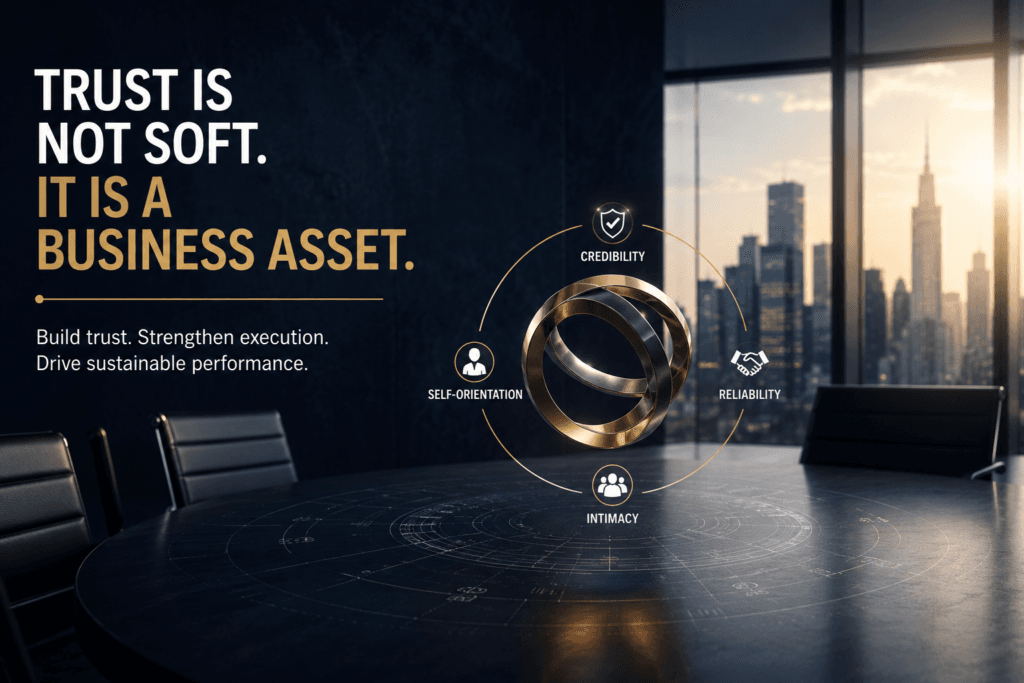
2. The Four Pillars of Trust
If the Five Dimensions reveal where trust affects performance, the Four Pillars explain what creates trust in the first place:
- Credibility — Confidence in expertise and capability
- Reliability — Confidence through consistency and follow-through
- Intimacy — People feel valued, heard, and safe to be direct
- Self-Orientation — Decisions driven by collective success, not self-interest
These pillars form the behavioural foundation on which high-trust organizations are built. Learn more about the Four Pillars of Trust
If Trust Is a Business Asset: Build It. Measure It. Manage It.
Every organization runs on systems — financial, operational, technological. But there is one system that determines how well all others perform: the trust system.
When trust is strong, organizations move with clarity, speed, accountability, and alignment. When trust is weak, everything slows, even when strategy is sound, talent is strong, and resources are available.
This is why trust must be treated differently. Not as a culture initiative or values exercise, but as infrastructure.
Once trust is seen as infrastructure, the conversation changes. The goal is no longer to “improve trust.” The goal becomes building it, measuring it, and managing it like any other system that drives performance.
That is where real transformation begins.
Interested in building a high-trust organization? The Trust Operating System™ provides a structured approach to diagnosing, measuring, and strengthening trust at every level of your business. Get in touch to learn more about the topic: Trust Is a Business Asset.
This article is part of the Trust Operating Systems series, in which I break down how trust shapes decision-making, execution, and growth inside organizations.
Start with the full framework here:
👉 Trust Operating Systems: How Organizational Trust Drives Execution