
- June 30, 2026
- Posted by: Nkem Mpamah
- Category: Organizational Trust
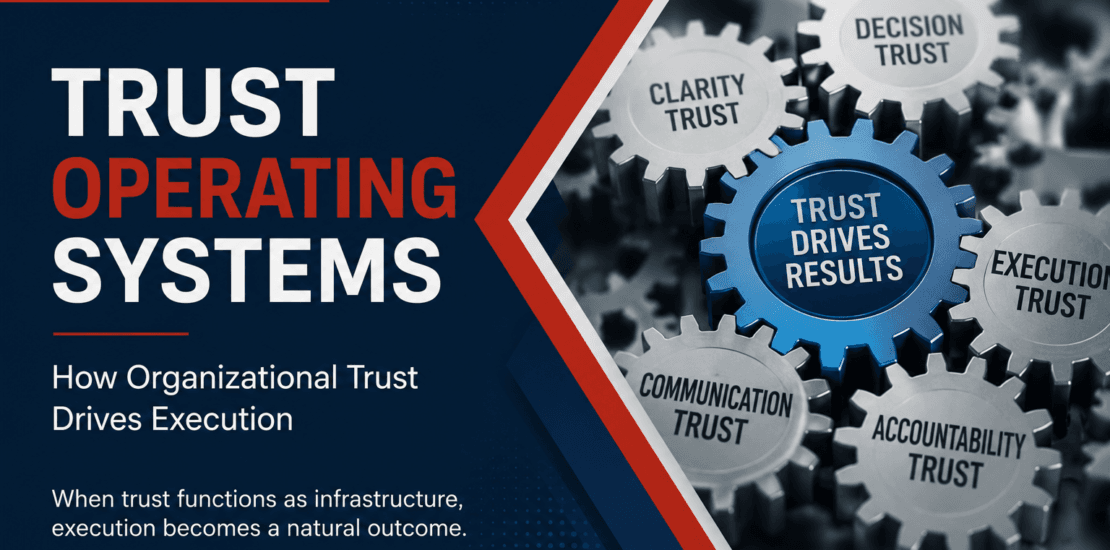
When organizations struggle, it is usually not because they lack strategy. More often, performance declines because organizational trust is weaker than leaders realize, causing work to move less smoothly than it should.
Decisions take longer than expected. Projects lose momentum. Teams become frustrated. Leaders spend more time following up than moving forward.
What makes this particularly difficult is that the problem often remains hidden. The organization appears busy. Meetings are happening. Tasks are being completed. People are working hard. Yet results consistently fall short of potential.
When this happens, leaders often search for answers in structure, process, or performance management. They redesign workflows, introduce new tools, and create additional layers of oversight.
Sometimes these interventions help. Oftentimes, they don’t, and the reason is simple: execution problems are not capability, effort, or resources. Rather, it is frequently trust problems in disguise.
Organizational trust is not merely a cultural concept. It is an operational force that determines how effectively work moves through an organization. It shapes how decisions are made, how leaders align, how accountability functions, and whether people act with confidence.
This is the foundation of the Trust Operating System™.
What Is a Trust Operating System™?
A Trust Operating System™ is the invisible framework that determines how work moves through an organization.
Just as a computer operating system determines how applications communicate and perform tasks sequentially, a trust operating system determines how people make decisions, communicate, execute, and take ownership to produce results.
When trust functions effectively, work flows naturally. Decisions move quickly, communication remains clear, accountability is sustained, and execution follows.
When the trust system breaks down, friction appears throughout the organization. Politics kicks in. Delays increase. Confusion grows. Decisions stall. Progress slows.
The difference is not intelligence or effort. The real difference is how trust operates.
Why Trust Matters More Than Most Leaders Think
Many leaders think about trust primarily as a cultural issue. They think about engagement, relationships, morale, and teamwork.
While these matter, trust has a far more practical role.
Trust determines how work moves through people in an organization. A trusted organization is not necessarily one where everyone agrees. It is one where people can make decisions, take ownership, and move forward without unnecessary hesitation.
When trust is strong, people act with confidence, make quicker decisions, share information faster, solve problems, and take ownership without hesitation.
When trust is weak, people become cautious. They second-guess, seek unnecessary approval, delay decisions, withhold information, and avoid responsibility.
Over time, these behaviours create friction throughout the organization, that friction becomes visible as slower execution, and performance drops.
This is why trust should be viewed as infrastructure rather than sentiment.
To understand how trust first affects the flow of work, start with Trust Infrastructure: The Hidden Problem Slowing Your Team.
The Five Dimensions of Organizational Trust
Trust influences performance through five interconnected dimensions. Together, they determine whether an organization can consistently convert strategy into results.
Clarity Trust
Execution begins with clarity.
People cannot move confidently when they are uncertain about priorities, expectations, responsibilities, or authority.
When Clarity Trust is strong, individuals understand what matters most, what success looks like, and where decision-making authority begins and ends.
When it is weak, confusion spreads. People spend more time seeking clarification than making progress. The result is hesitation, duplication of effort, and slower performance.
Decision Trust
Once people have clarity, they must be able to make decisions.
Decision Trust reflects the confidence people have that decisions can be made, supported, and sustained.
In healthy organizational trust environments, decisions move forward and remain intact. People trust that acting within their authority will be supported.
In unhealthy environments, decisions are revisited repeatedly, delayed unnecessarily, or quietly reversed after they are made. Momentum disappears.
This challenge is explored further in Why Teams Circle Decisions and Progress Stalls and Why Some Teams Decide Faster Than Others (And It’s Not Experience).
Execution Trust
A decision only creates value when it becomes action. Execution Trust determines whether commitments translate into meaningful progress.
When it comes to performance, many leaders mistake agreement for execution. Time and again, teams leave meetings aligned, but does little or nothing to change the situation.
When Execution Trust is strong, work moves forward naturally. People follow through because commitments are clear, understood, and trusted.
When it is weak, leaders find themselves constantly chasing updates, issuing reminders, and monitoring progress. In environments where organizational trust is active, execution trust simply closes the gap between intent and action.
For a deeper look at this challenge, read Why Work Doesn’t Get Done (Even When Everyone Agrees).
Communication Trust
Communication is one of the most overlooked drivers of organizational performance. Communication Trust reflects the extent to which information flows openly, accurately, and credibly throughout the organization.
When communication is trusted, people act with confidence because they believe the information they receive is timely and reliable.
When communication trust is weak, uncertainty increases. People rely on assumptions, rumours, incomplete information, or informal channels. As uncertainty grows, decision-making slows, and execution suffers.
In many organizations, leaders attempt to solve execution problems without addressing the communication breakdowns that created them.
Accountability Trust
Accountability is often misunderstood as a discipline issue. In reality, it is frequently a trust issue.
When Accountability Trust is strong, people willingly take ownership of commitments because expectations are clear and support is available.
When it is weak, responsibility becomes unclear. Ownership is avoided. Leaders compensate with additional oversight and control.
The result is a culture where teams comply without commitment. This dynamic is explored in Why Accountability Fails in Most Organizations.
Why Good Organizations Still Struggle
Most execution failures are not caused by a lack of effort. They are caused by friction.
Friction appears when people hesitate before acting, when they repeatedly revisit decisions, seek unnecessary permission, withhold information, or avoid ownership.
That permission-seeking behaviour is one example of this friction. It sabotages organizational trust, and stops talented teams from moving forward because acting feels riskier than waiting.
I explored permission trap deeply in The Permission Trap: Why Your Best People Are Waiting Instead of Moving.
While each behaviour may seem small on its own, collectively, they erode organizational trust. Over time, they compound and reduce the speed of performance.
The Relationship Between Organizational Trust and Speed
Organizational Speed Is a Trust Outcome. The fastest organizations are not necessarily the hardest-working organizations.
They are the organizations with the least friction:
- They make quicker decisions because authority is clear;
- Execute faster because commitments are trusted;
- Communicate better because information flows openly.
- Maintain accountability because ownership is supported.
In this organization, the result is greater speed, adaptability, and high performance.
As I explored in The Hidden Factor Behind Fast-Growing Organizations, organizational speed is often the visible outcome of healthy trust systems.
The Bottom Line
Trust is not a soft concept. It is a performance system.
When Clarity Trust, Decision Trust, Execution Trust, Communication Trust, and Accountability Trust function together, organizations move faster and perform better. Decisions become easier. Communication improves. Execution accelerates. Ownership strengthens.
The organizations that consistently outperform their competitors understand this.
They do not treat organizational trust as a cultural initiative.
Instead, they treat it as infrastructure.
And when trust becomes infrastructure, performance becomes a natural outcome.

Author:
Nkem Mpamah
Nkem Mpamah is a management and transformation consultant advising boards, CEOs, founders, and executive teams on execution speed, leadership alignment, and organizational effectiveness. He is also the creator of the Trust Operating System™ (Trust OS™). Learn more about Nkem Mpamah or connect with him on LinkedIn.