
Executive Summary
Many organisations confuse compliance with accountability. They are not the same thing.
Compliance means following rules, policies, and regulations. Good governance needs it. But compliance alone does not make people take ownership or get things done.
Executive accountability goes further. It means leaders know what they are responsible for, have the authority to act, raise problems early, and take ownership of the results within their control.
An organisation can have detailed policies, clear reporting lines, and strong performance reviews, and still struggle to deliver.
Why? Because being given responsibility on paper is not the same as taking ownership in practice.
Most of the time, poor delivery does not come from weak people or a poor strategy. It happens when no one is sure who is responsible, people lack the required authority to decide, communication is patchy, and everyone is busy protecting themselves instead of solving problems.
The result is an accountability gap — projects stall, decisions are delayed, risks stay hidden, managers wait for approval, and senior leaders get pulled into day-to-day matters that should have been settled earlier.
This is where trust matters. The Trust Operating System™ is a simple framework that examines how trust shapes communication, decision-making, results delivery, and ownership.
The goal is not to remove rules or let everyone do as they please. It is to create the right conditions for people to take responsibility, make decisions within clear limits, and answer for their part in the organisation’s results.
Executive accountability is not just something leaders expect from others. Instead, it should be designed into an organization’s operating system, supported, and kept alive.
1. The Problem: Responsibility Without Ownership
Imagine an organisation launches an important new project.
The leadership team agrees on the goals. Each department gets its tasks. Meetings are scheduled. Reporting forms are introduced. Everyone seems to know what to do.
Months later, progress is disappointing. The project is behind schedule. Departments are blaming each other. Risks that should have been spotted early are now hurting delivery.
The usual response is another meeting, a new committee, more reports, or a call for more commitment.
But what if commitment was never the problem? What if the organisation never set up the conditions for people to take real ownership?
THE DIFFUSED OWNERSHIP CYCLE
┌──────────────────────────────────────────────────┐
│              A Project Hits a Problem            │
└────────────────────────┬─────────────────────────┘
                         │
                         ▼
┌──────────────────────────────────────────────────┐
│       It becomes unclear who is responsible      │
└────────────────────────┬─────────────────────────┘
                         │
                         ▼
┌──────────────────────────────────────────────────┐
│          The decision is passed between          │
│            departments or committe               │
└────────────────────────┬─────────────────────────┘
                         │
                         ▼
┌──────────────────────────────────────────────────┐
│          People worry about being blamed         │
└────────────────────────┬─────────────────────────┘
                         │
                         ▼
┌──────────────────────────────────────────────────┐
│          The problem is delayed, hidden,         │
│              or only half solved                 │
│                                                  │
└────────────────────────┬─────────────────────────┘
                         │
                         ▼
┌──────────────────────────────────────────────────┐
│      Progress slows and resources are wasted     │
│                                                  │
└──────────────────────────────────────────────────┘
Here is the key point. An organisation can give someone responsibility for a project without giving them the authority, information, or the accountability to move it forward.
When that happens, people stay busy, but little gets done. Everyone is working, yet no one is responsible for taking the project from problem to solution.
The Committee Shield
Committees are useful when a decision needs different skills, coordination, or shared oversight.
They become a problem when they override individual ownership.
When a project runs into trouble, Management often sets up a committee to review it. The committee may give good advice. But then who makes the decision? Who has the authority to act? Who makes sure the actions happen? Who answers for the result?
If nobody can answer, shared responsibility becomes an easy way to avoid personal accountability.
Teamwork should strengthen ownership, not replace it.
A committee can advise and oversee. But one named leader must still be made responsible for delivering the agreed result.
When Following Rules Replaces Taking Action.
Another problem starts when a culture cares more about avoiding mistakes than solving problems.
Managers learn to follow procedures to the letter, obtain several approvals, and document every decision. This can look responsible. But when fear of blame drives behaviour, following the rules becomes a way to stay safe.
A manager may see that a decision is needed but hold back because the procedure manual does not cover it. Instead of using their judgement, they wait for instructions. Instead of reporting a risk, they wait until they have enough proof to protect themselves. Instead of owning a problem, they escalate it to senior management.
The organisation becomes more compliant, but slower to respond.
This is not a proposal against governance, policies, controls, or regulations. My point is that while compliance keeps certain activities in check, it should not replace judgement, initiative, and ownership.
Good governance sets the limits within which people can use sound judgement. It should not make people afraid to act.
The Trust Tax on Leaders
When executive accountability is weak, the cost spreads well beyond the people directly involved.
Senior leaders start to fill the gaps themselves. They ask for more updates. They step into departmental decisions. They chase tasks that should already be done. They settle disagreements that should have been resolved at a lower level.
Over time, the leadership team spends more time checking on activity than guiding the organisation.
I call this the Trust Tax. It is what an organisation pays when trust is low or missing: extra supervision, slow decisions, repeated conversations, needless approvals, and less time for leaders to lead. The cost does not always show up in the P&L accounts. But it shows up in slower delivery, frustrated managers, wasted resources, and missed opportunities.
And the more leaders step in to make up for weak ownership, the less chance the organisation has to build the ability to take ownership on its own.
2. Accountability Is About How the Organisation Is Set Up, Not Just Motivation
Many organisations treat accountability as a question of attitude. When results fall short, leaders ask for more commitment, remind people of their duties, set new targets, and repeat their expectations more firmly.
These steps may help, but they do not fix the real accountability problem.
People cannot take consistent ownership of a result unless the organisation has made clear:
- What they are expected to deliver
- What decisions they are allowed to make
- What information they need
- Who they must consult
- When to raise a problem with a senior leader
- How their performance will be judged
- What happens when commitments are not met
Without these basics, accountability is just an expectation with no support behind it. A person is held responsible for a result they have little power to influence. That leads to frustration and defensive behaviour.
You cannot build real accountability by adding responsibility while leaving decision-making power where it was.
Strong executive accountability thrives on five things: responsibility, authority, information, resources, and consequences. When these are in place, ownership stops being a slogan and becomes how work is done every day.
3. Building Ownership with the Trust OS™
The Trust Operating System™ looks at accountability through the conditions that shape how people work together.
Trust is more than a good feeling between colleagues. It decides whether people can speak honestly, decide with confidence, deliver reliably, and take responsibility without needless friction.
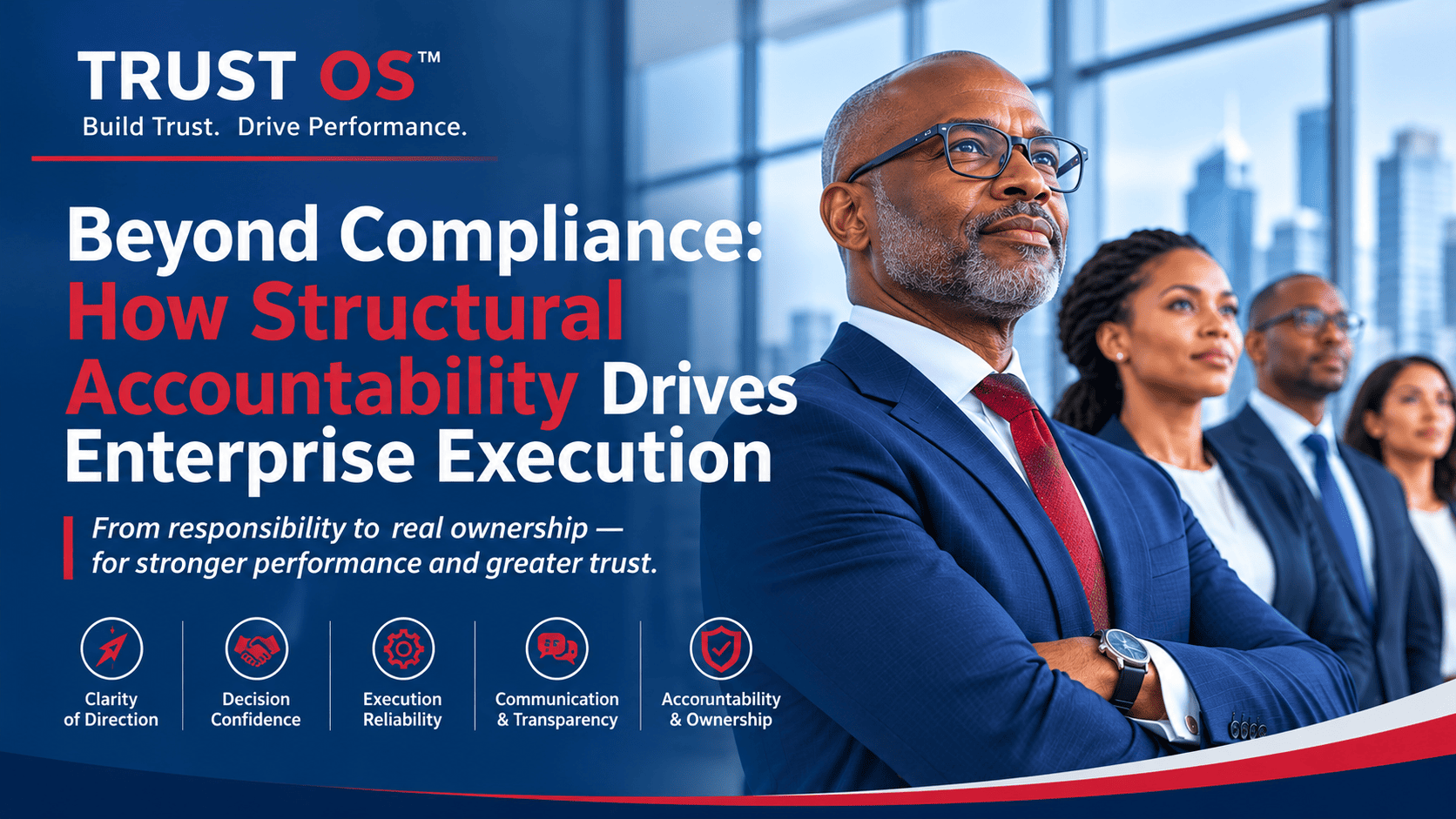
The Trust OS™ looks at accountability alongside four other areas that affect performance:
- Clear Direction: Do people know where the organisation is going?
- Confident Decisions: Do people know who can decide what?
- Reliable Delivery: Do people do what they promised?
- Open Communication: Do people share information and problems honestly?
- Accountability & Ownership: Do people take responsibility for their part?
These areas are interconnected. Consider a leader held accountable for a major goal. If the direction is unclear, they may not know what success looks like. If their authority is limited, they may be unable to act. If communication is poor, critical information may arrive late, or not at all. And if other departments fail to meet their commitments, the outcome may depend on factors beyond their control.
That’s why executive accountability cannot be considered in isolation.
What Each Area Needs for Accountability to Work
| Area | What accountability needs |
|---|---|
| Clear Direction | People understand the goal, priorities, and results expected. |
| Confident Decisions | It is clear who can decide what, and when to involve someone more senior. |
| Open Communication | Risks, dependencies, and problems are shared early. |
| Reliable Delivery | Commitments and milestones are tracked, and people follow through. |
| Accountability & Ownership | Individuals take responsibility for their part and the agreed results. |
The aim is a workplace where ownership is backed by the support people need to deliver.
Reliability: Turning Promises into Results
Reliability is a key foundation of accountability.
When leaders keep their commitments, share information openly, and follow through, others can plan and work with more confidence. This is especially important when several departments must work together.
Consider this example. The finance team must approve funding for a major project. The project team cannot start until the decision is made. If the approval process is unclear or keeps getting delayed, the project team misses its deadlines.
It may look like the project team failed. But the real problem was an unreliable decision process.
So accountability means asking more than “Did this person finish their task?” It also means asking whether commitments across the whole organisation are being kept in a way that supports the shared goal.
Reliable delivery is the result of the entire people and teams doing what they said they would do.
Putting the Organisation First, Not Self-Protection
One of the four foundations of trust is how much a person focuses on their own interests instead of the interests of the team or organisation. I call this self-focus.
In the workplace, too much self-focus shows up in familiar ways:
- A manager hides information because sharing it would expose a mistake.
- A leader resists a decision because it might affect their reputation.
- A department chases its own targets even when this causes problems for another department.
- A person spends their energy explaining why it wasn’t their fault instead of helping to fix the problem.
These habits weaken ownership because protecting oneself becomes the main concern.
Leaders with less self-focus are more willing to admit difficulties, share uncomfortable news, and help find solutions that serve the whole organisation. This does not mean avoiding responsibility or taking the blame for everything. Rather, it means telling the difference between protecting your reputation and protecting the organisation’s performance.
Real accountability means being willing to deal with a problem even when it is uncomfortable.
4. How to Tell if Executive Accountability Is Working
Accountability is easier to improve when you can see how it works in practice.
Instead of judging ownership only in yearly reviews, look at everyday behaviour and the way work is set up. These signs are a good place to start.
| What to look at | Weak accountability | Strong ownership |
|---|---|---|
| Raising problems | Problems are hidden or raised only when failure is unavoidable. | Risks and issues are shared early, along with ideas to fix them. |
| Decisions | Decisions keep getting passed upwards or between committees. | It is clear who decides, and when to involve someone more senior. |
| Delivery | Deadlines are missed, and no one knows who is responsible. | Every milestone has an owner, and progress is checked regularly. |
| Working across teams | Departments protect their own priorities and pass problems along. | Teams work together toward shared goals and solve problems jointly. |
| Handling mistakes | People defend themselves or look for someone to blame. | Leaders admit what happened, find the cause, and fix it. |
| Follow-through | Meetings produce actions, but few are completed. | Every action has an owner, a deadline, and visible progress. |
These signs help you tell the difference between an organisation that reports activity and one that takes responsibility for results.
Accountability does not mean there are no problems. It means problems are spotted, shared, and resolved well.
An organisation that brings problems into the open may at first seem to have more of them than one where problems stay hidden. But seeing problems early gives you the chance to fix them while they are still small and cheap to solve. The goal is not to build a workplace where nobody makes mistakes. Instead, to have a workplace where mistakes and risks are dealt with openly, not hidden or blamed on others.
5. Five Practical Steps to Strengthen Executive Accountability
How can leadership teams put these ideas to work? Here are five practical steps.
1. Give Every Major Goal a Clear Owner
Every important project or goal needs one named owner.
That person should understand the expected result, how success will be measured, the key milestones, and what other teams must contribute. They should also have the authority to coordinate the work and solve problems within agreed limits.
A simple responsibility chart (who does the work, who is accountable, who must be consulted, and who needs to be informed) can help. But keep it practical. Its purpose is to make roles clear enough for people to act, not to create more paperwork.
For every major project, leaders should be able to answer:
- Who owns the result?
- Who makes the key decisions?
- Who needs to contribute?
- Who needs to be kept informed?
- What happens when progress is blocked?
If you cannot answer these questions clearly, you may have a list of responsibilities but not real ownership.
2. Make It Safe to Raise Problems Early
Good decisions depend on good information. When people fear being punished for bad news, they delay sharing it. That creates a dangerous gap between what is really happening and what senior leaders believe is happening.
So look at how you respond when people raise concerns:
- Do you ask questions to understand the situation?
- Do you separate an honest mistake from deliberate wrongdoing?
- Do you encourage people to fix the problem?
- Or do you look for someone to blame?
Your response decides whether people will speak up next time.
A high-trust workplace still has consequences. But it makes honest communication safe, while keeping clear standards for responsible behaviour.
The earlier a problem is raised, the better the chance of solving it before it becomes a failure.
3. Match Decision Authority to Responsibility
One of the most useful steps is to make clear which decisions people can make.
Managers should not need approval for every routine decision. But they also should not be expected to make decisions beyond their authority or that put the organisation at risk.
Leaders should set clear limits:
- Which decisions can people make on their own?
- Which need consultation first?
- Which need senior approval?
- When must an issue be escalated immediately?
These limits should reflect the organisation’s strategy, legal duties, risk tolerance, and day-to-day reality.
When authority is clear, managers act with confidence. When it is vague, even capable leaders become overly dependent on senior executives.
4. Link Accountability to Real Team Results
Performance reviews should go beyond looking at whether people finished their tasks. They should also ask whether their work helped the organisation reach its goals.
Here are some examples:
- A department hits its target but causes delays for another department.
- A manager finishes a project on time but fails to share a serious risk.
- A team follows the process perfectly but misses a chance to get a better result.
In each case, individual performance and organisational performance do not match.
Accountability should therefore cover:
- Keeping agreed commitments
- Making good decisions
- Sharing risks and dependencies
- Working well with other teams
- Taking corrective action when things go wrong
Reward real ownership, not just visible activity.
5. Build a Regular Rhythm of Progress Checks
Accountability needs regular habits to keep it going. Important projects should have clear milestones, regular progress reviews, and a way to clear obstacles.
These reviews should not become extra reporting or tough questioning. Their purpose is to show where things stand, spot risks early, and ensure that commitments are being kept.
A good progress review answers four questions:
- What did we promise to do?
- What has been done?
- What is getting in the way?
- What needs to happen next, who will do it, and by when?
Over time, the organisation relies less on reminders and gets better at managing delivery through steady habits.
6. Why Executive Accountability Pays Off
When accountability is well designed, the benefits reach well beyond individual performance.
More Time for Leaders to Lead
Executives spend less time chasing updates, settling avoidable disagreements, and making decisions that others should make. That frees them to focus on strategy, resources, people development, and long-term results.
Faster, More Confident Decisions
Clear decision rights mean fewer unnecessary approval steps. Managers know what they can decide, and executives stay involved only where they are needed.
More Reliable Delivery
When responsibilities, milestones, and dependencies are clear, teams work together better. Problems show up sooner, commitments are easier to track, and action can be taken before delays grow.
Greater Confidence from Boards and Stakeholders
Boards and investors need honest information about performance. When accountability is clear and risks are shared openly, leaders can give a more reliable picture of progress, challenges, and the actions being taken.
Stronger Trust
Most importantly, clear accountability builds trust. People become more confident that promises will be kept, decisions will be made properly, problems will be shared, and responsibility will not disappear when things get difficult.
Trust then becomes more than hope. It becomes part of how the organisation works.
7. A Question Every Leadership Team Should Ask
Before introducing another performance programme, accountability policy, or reporting rule, ask yourselves:
Have we built an organisation where people feel empowered to take ownership, or one where they mainly try to protect themselves from blame?
Your answer matters for delivery. Here is where to look:
- If responsibility is unclear, make ownership clear.
- If decision authority is too tight, set sensible limits.
- If communication is unreliable, deal with what makes people hold back.
- If commitments keep being missed, look at what’s getting in the way of follow-through.
- If executives spend too much time on day-to-day matters, ask whether the organisation has built enough ownership of its own.
The answer is not always to demand more accountability. Sometimes it is to remove what is stopping accountability from working.
Conclusion: Executive Accountability Is a Skill Organisations Can Build
Compliance remains essential to good governance. But on its own, it cannot guarantee initiative, ownership, or reliable delivery.
Organisations need structures that help people understand their responsibilities, use their authority wisely, communicate openly, and take ownership of results. That takes more than defining roles or running performance reviews. It means looking closely at the conditions that shape how people work together.
The Trust Operating System™ helps leaders see how clear direction, confident decisions, reliable delivery, open communication, and accountability work together to drive performance.
The aim is to move from people simply doing their assigned tasks to people contributing meaningfully to the organisation’s results. Because when executive accountability is well supported, ownership becomes consistent, decisions become confident, and delivery becomes reliable.
That is where trust starts to turn into performance.
Strengthen Executive Accountability in Your Organisation
How clear are ownership, decision-making, communication, and delivery responsibilities in your leadership team?
The Trust Operating System™ offers a practical way to look at the conditions that shape trust, alignment, and performance.
You can explore the framework or request an executive briefing.